
Why Jackknifing Is One of the Most Terrifying Truck Failures
A “jackknife” is the single most catastrophic loss of control a tractor-trailer can experience. It occurs when the trailer swings sharply toward the cab, creating an angle resembling a folding pocketknife. This sudden, violent maneuver instantly transforms the truck from a linear vehicle into a massive, uncontrolled barrier sliding sideways across the highway. The resulting chaos is immediate and almost always involves multiple innocent vehicles.
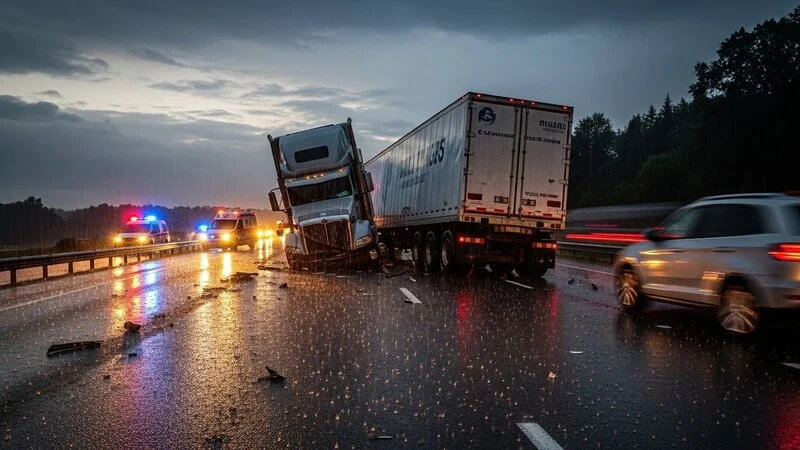
The phenomenon is so dangerous because it typically happens at speed, often on major highways, and gives surrounding drivers zero time to react. Once the angle between the tractor and trailer exceeds a critical point, the event becomes physically irreversible; the driver loses all steering and braking control over the rig, turning the vehicle into an 80,000-pound projectile.
Understanding the dynamics of a jackknife is essential for investigating the accident’s root cause, as it frequently points to driver error, speed, or defective equipment. The catastrophic nature of jackknife truck accidents guarantees that the liability and injury claims will be severe and complex.
How Braking and Trailer Movement Trigger Jackknifes
A jackknife is primarily triggered by excessive, uneven, or sudden braking, especially in conditions where tire traction is compromised. When a driver brakes too hard or too quickly, the wheels of the tractor may lock up, while the heavy momentum of the trailer continues to push forward.
If the truck is slightly turning or is hit by a strong side wind during this moment, the trailer begins to slide laterally. Once the angle between the cab and the trailer hits a critical threshold—where the trailer’s momentum overcomes the truck’s resistance—the folding action becomes inevitable, leading to a full loss of control.
In many jackknife truck accidents, the initial brake failure or driver’s panic-braking response is the root human error. This immediate reaction, intended to prevent a collision, instead triggers the most dangerous possible truck failure, demonstrating the complexity of driving such massive equipment.
How Road and Weather Conditions Contribute
While driver action is often the direct trigger, road and weather conditions play a significant role in making a jackknife possible. Slippery road surfaces are the most common environmental factor, as snow, ice, or wet pavement drastically reduce the necessary friction between the tires and the road.
On a slick surface, the necessary braking force to stop is much lower, meaning the wheels lock up faster. When the tractor wheels lose traction, they cannot maintain a straight line, and the rear of the trailer immediately begins its dangerous swing. Even a slight curve can initiate the event if traction is poor.
Furthermore, factors like downhill slopes or severe crosswinds can also destabilize the rig, requiring the driver to use excessive counter-steering or braking to maintain control. When compounded with poor driver judgment, these conditions turn minor maneuvers into dangerous precursors to a full jackknife.
How Jackknifes Create Multi-Vehicle Crashes
A jackknifed truck creates an immediate, impassable barrier that guarantees multi-vehicle involvement. The rig typically spans multiple lanes, completely blocking traffic flow and forcing surrounding vehicles into high-speed defensive maneuvers that often result in secondary collisions.
The trailer’s sudden, sideways movement acts like a sweeping arm, side-swiping cars in adjacent lanes before settling across the road. Vehicles traveling behind the truck have minimal warning—sometimes only the brake lights of the cab—before they encounter the massive, solid side of the trailer.
These scenarios commonly lead to massive pileups, especially on busy, multi-lane highways. In these catastrophic jackknife truck accidents, the liability chain points clearly back to the driver or company responsible for the initial loss of control, making them responsible for the injuries sustained by dozens of subsequent victims.
Why Injuries Tend to Be Severe
The injuries resulting from a jackknife accident are notoriously severe due to two primary factors: the massive transfer of kinetic energy and the mechanism of impact. Passenger vehicles often collide with the side of the trailer, which is structurally rigid and provides no crumple zone protection for the car’s occupants.
This side-impact (or T-bone) collision against the rigid metal of the trailer often results in catastrophic injuries, including traumatic brain injuries, spinal cord fractures, and internal organ damage. Fatalities are tragically common due to the sheer destructive force.
Even if the vehicle manages to avoid the direct impact, the sudden chaos and speed often cause secondary collisions with other vehicles or barriers. The high-speed nature and the multi-vehicle involvement ensure that the resulting medical claims are complex, high-value, and life-altering for the survivors.
Why Jackknifing Is So Hard to Avoid Once It Starts
Jackknifing represents the ultimate loss of control for a commercial truck driver. Once the angle of the trailer exceeds the critical threshold, the physics of momentum take over, making the event virtually impossible to correct through steering or gentle braking.
The only way to avoid jackknife truck accidents is through preventative measures: avoiding excessive speed, maintaining safe following distances, inspecting brakes diligently, and adapting driving style drastically to poor weather conditions.
For accident victims, the terrifying nature and devastating impact of a jackknife mean that their legal case must focus on the negligence that preceded the loss of control—whether it was the driver’s actions or the company’s lack of maintenance.
