
Lansing Car Accidents: Causes & How to Avoid
Lansing’s roads follow a consistent pattern. You share them with government commuters, students, and city residents every day. This volume concentrates on key corridors: Highways 496 and 127, and Saginaw Highway. These routes experience steady congestion. Intersections along them are frequent trouble spots, particularly during Michigan’s variable weather. Accidents occur regularly as a result.
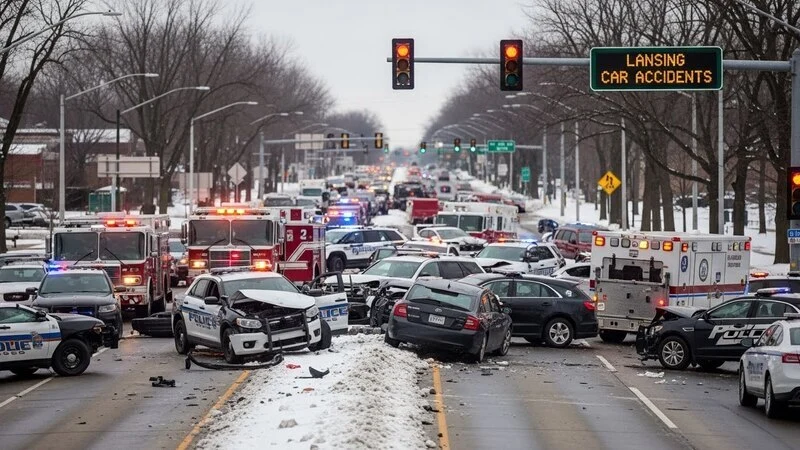
Protect yourself by learning this traffic pattern. Anticipate hazards ahead—local knowledge is key to defensive driving.
Distracted Driving in City Traffic
The cause is often a moment of diverted attention. That’s the simple, dangerous truth behind numerous crashes here. In city traffic, the margin for error shrinks to almost nothing. You have the predictable rhythm of signals and lanes, yes, but layered over that is a chaotic, living system—people crossing against the light, a cyclist swerving to avoid a door, a bus merging.
Places like Michigan Avenue and the downtown district concentrate these elements. Conditions don’t just change; they fracture. One second is clear, the next demands an immediate reaction. Eating, talking, even adjusting the climate control—these mundane acts pull your focus at the worst possible time.
A momentary glance away from the road can easily result in a rear-end collision or a pedestrian accident.
Ways to cut down on it:
- Make your phone inaccessible: The glovebox is your friend. If it’s out of reach, you can’t use it.
- Be ready before you go: Have your map or playlist set before you’re in the drive.
- Keep meals for stops: Eating and drinking can wait until you’re parked.
- Know the danger zones: Stay especially focused near schools, college campuses (like MSU), and complex intersections.
These simple actions are highly effective. Make them a habit, and you will dramatically improve your safety on the road.
Speeding on Highways and Local Roads
Speeding continues to be a primary factor in serious Lansing collisions. On major routes, drivers frequently go faster than the limit, misjudging safe conditions. This reduces reaction time and amplifies crash forces. The threat is especially acute for vulnerable road users on local streets.
Ongoing road construction further complicates traffic flow. These zones implement lower speed limits and lane restrictions for safety. Disregarding these changes by speeding endangers everyone in the area.
How to reduce the risk:
- Obey posted speed limits.
- Slow down near construction projects.
- Leave earlier to avoid rushing.
- Drive more cautiously in poor weather conditions.
What to Do After a Car Accident in Lansing
A Lansing car accident changes everything in a heartbeat. Follow these steps. First, assess injuries. Dial 911 immediately for any possible harm. Even a small ache matters. Next, if it’s safe, move the cars from the flow of traffic. Then, turn your phone into a witness.
Take photos of all damage, every angle, the surrounding scene, and license plates. Get the other driver’s information: name, insurance company, policy number, phone. Find witnesses and note their details. Don’t talk about who caused it. Don’t apologize. Right now, you’re just collecting facts. Let the pictures and documents do the talking later.
After an accident, understand your insurance and injury claims. For insight into the process and your legal options, consult a professional. You can visit The Clark Law Office for direct guidance on handling insurance matters and injury claims, providing a reliable framework for your subsequent actions.
Weather Conditions and Seasonal Hazards
Adverse weather in Lansing is a reliable cause of collisions, plain and simple. Fog blots out the world. Snow turns the roads to paste. And ice steals all traction from your tires. The worst is black ice—that invisible sheen waiting like a trap. The real trouble lingers long after the skies clear, though.
Winter’s repeated freeze-thaw cycles fracture asphalt, creating potholes and rough pavement. Hitting these areas can destabilize a vehicle. The risk is amplified for drivers without local experience, who are less able to identify and avoid these known trouble spots.
Here’s how to drive more safely in these conditions.
- Slow down during rain, fog, or snow.
- Increase the following distance in icy conditions.
- Drive with headlights on during low visibility.
- Maintain tires for seasonal driving.
Intersection Risks
Accidents in Lansing are most common at intersections. Typical reasons are attempting to beat a red light, not stopping fully, and yielding incorrectly.
These hazards are intensified in areas with dense traffic flow, including downtown. A specific and serious threat is turning left in front of approaching traffic on the assumption it will stop, which commonly causes dangerous T-bone impacts.
Minimize distractions with these key steps:
- Always pause and scan before entering any intersection.
- Be ready for others to run red lights—it happens.
- Make eye contact with pedestrians and cyclists.
- Stay in your lane; avoid last-second aggressive changes.
Impaired and Fatigued Driving
Impaired and fatigued driving aren’t just statistics here—they’re a real, ugly part of Lansing’s crash reports. Alcohol’s the obvious one, but medications and other drugs play a huge and quiet role. And then there’s just being tired. That bone-deep fatigue slows you down almost as much as a couple of beers, turning a simple drive into a gamble.
Late nights. Long shifts. Dragging yourself home after pulling a double. On quieter roads, that’s when a single mistake becomes permanent.
Your move is straightforward. If you’re under the influence of anything, your keys are off-limits. Plan for rest before a big drive. And if you’re even questioning whether you’re too tired, you already have your answer. Call a ride.
Inexperienced Drivers
Lansing’s younger, less-experienced drivers are more prone to distraction, slower reaction times, and errors in judging distance.
How to reduce the risk:
- Encourage defensive driving education.
- Limit distractions for new drivers.
- Practice during low-traffic hours.
- Build experience in different weather conditions.
Conclusion
Driving in Lansing requires focus. You can’t control other drivers, but you can manage common risks like distractions, bad weather, and speeding.
Prevention is straightforward: check the forecast, slow down in poor conditions, and plan your route ahead of time. These simple steps are your best defense against an accident.
