
Symptoms of a Failing Rack and Pinion (and What Causes It)
Your rack and pinion is the mechanical bridge between your steering wheel and your front wheels. When it starts failing, you’ll know — the car tells you in several ways, and most of them are hard to ignore once you know what to listen for. The short answer: loose or wandering steering, clunking or grinding noises when turning, power steering fluid on your driveway, and a wheel that doesn’t return to center are the main signs something is wrong.
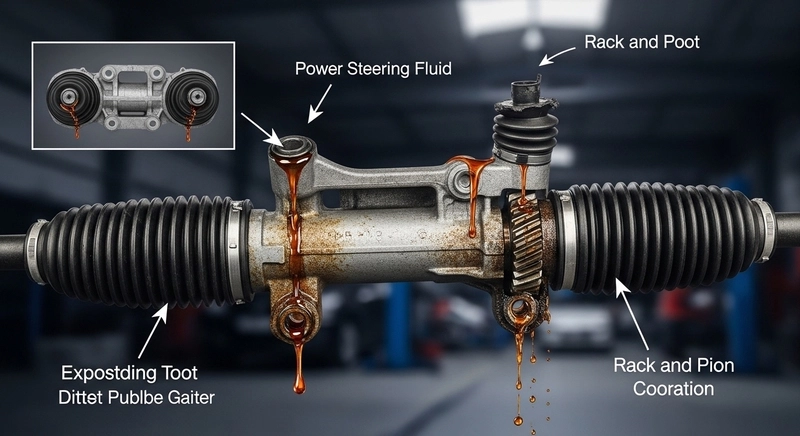
This isn’t one of those problems that gets better on its own.
Quick Summary
- Loose or wandering steering — the wheel has too much play, or the car drifts
- Unusual noises — clunking, grinding, or knocking when you turn
- Power steering fluid leak — reddish-pink puddle under the front of the car
- Uneven tire wear — especially on the front tires, often one-sided
What a Rack and Pinion Actually Does
The rack and pinion is a gear set. The pinion is a small round gear on the end of your steering column. The rack is a flat bar with teeth cut into it. When you turn the wheel, the pinion rotates and pushes the rack left or right, which in turn moves your front wheels. It’s a simple, direct system — and on most modern cars, it replaced the older recirculating-ball steering because it gives better feedback and precision.
On power-assisted versions (which is most cars on the road today), hydraulic pressure or an electric motor reduces the effort needed to turn. When the rack starts wearing out or leaking, that assist disappears, and steering gets heavy or unpredictable.
Signs of a Failing Rack and Pinion
1) Excessive Play in the Steering Wheel
Excessive play means the steering wheel moves noticeably before the front wheels respond. A little looseness is normal — maybe an inch or so of free rotation at the rim. But if you can rock the wheel several inches back and forth without the car changing direction, the rack is likely worn or the steering column connection is compromised.
I had a customer last spring with a 2011 Camry — she said her car “felt like it was steering through sand.” The wheel had almost three inches of play at the rim. The rack bushings were shot and the rack itself had worn gear lash. It had probably been building for two years before she noticed it enough to ask.
2) Clunking or Grinding Noises When Turning
These are probably the most common complaints I hear. A thunk or knock when you move the steering wheel — especially at low speeds or in a parking lot — usually points to worn rack bushings or loose tie rod ends connected to the rack. Grinding, on the other hand, suggests metal-on-metal contact inside the rack assembly, often because the internal lubricant has broken down or leaked out.
Distinguishing between noise from the rack itself and noise from a worn tie rod end matters. If the clunking happens at the wheel when stationary, tie rods are suspect. If the noise is more central, behind the dash or firewall area, focus on the rack.
3) Power Steering Fluid Leak
Power steering fluid is typically reddish or pinkish and has a slightly sweet, oily smell. If you’re finding puddles under the front of the car after it’s been parked overnight, the rack seals are a common culprit. The rack uses high-pressure fluid to assist steering, and the seals on either end degrade over time — especially past 80,000 to 100,000 miles.
A slow leak is easy to miss until your reservoir runs low and the pump starts whining. At that point you’re looking at pump damage on top of the original seal issue. Check your fluid level if you notice any unusual whine when turning.
4) Steering Wheel Doesn’t Return to Center
After a normal turn, the steering wheel should self-center when you release it. If it doesn’t — or if it returns sluggishly — the rack may be binding internally, or a worn mounting bushing is creating too much friction. This issue gets worse in cold weather because thick or degraded fluid moves slowly.
5) Vehicle Pulls to One Side or Wanders
A car that constantly drifts or requires constant correction to go straight is annoying at minimum and genuinely dangerous on a highway. Worn rack teeth on one side can cause uneven resistance.
Misalignment caused by a loose rack can also produce a pull. This is one of those symptoms where the rack is sometimes the culprit, but worn tie rods or alignment issues can cause the same thing — so diagnose before replacing.
Problems like this one are also closely related to common suspension and tyre problems that contribute to road accidents, which are worth reviewing if you’re seeing handling issues alongside uneven wear.
6) Uneven or Rapid Tire Wear
A failing rack that’s lost its precise centering will let your front wheels run slightly off-angle. The result is feathering or scalloping on one or both front tires, sometimes on the inner or outer edge specifically. If you’re replacing front tires more often than rear tires, the steering geometry is worth checking.
What Causes a Rack and Pinion to Fail
The main causes, in rough order of how often I see them:
- Age and mileage — Most racks last 100,000 to 150,000 miles. After that, internal wear and seal degradation accelerate.
- Low power steering fluid — Running low starves the seals and causes premature wear inside the rack.
- Hard impacts — Hitting a curb, a large pothole, or a road hazard at speed sends shock directly into the rack. One bad hit can crack a seal or bend internal components.
- Contaminated fluid — Old fluid gets acidic and breaks down seals from the inside. Most manufacturers recommend flushing the power steering system every 50,000 miles, and almost nobody does it.
- Heat cycles — In hot climates, repeated expansion and contraction of the rack housing degrades seals faster. This is more of a problem in the Southeast and Southwest than in cooler states.
The impact issue is worth emphasizing. A shop in Georgia that I worked at for a few years saw a lot of rack replacements on fleet vehicles that ran the same rough city routes. ONE bad curb strike at the right angle can crack an internal seal, and the damage won’t show up as a leak right away — sometimes it takes six months before the failure becomes obvious.
Why You Shouldn’t Ignore It
A worn rack doesn’t fail all at once in most cases, but the endpoint of ignoring it is a car that steers unpredictably or stops responding to the wheel altogether. That’s a genuine accident risk. Loss of steering control is among the more serious mechanical failure modes a driver can face, and the consequences of a steering-related crash are often severe. The injuries common in rear-end collisions — which can result when a driver loses vehicle control — are a useful reminder of what’s at stake when a mechanical issue gets ignored long enough.
Beyond safety, ignoring a bad rack turns a moderate repair into a large one. Fluid loss damages the pump. Loose steering causes accelerated tire wear. Worn bushings stress tie rod ends. What might be a $400 seal job becomes a $1,500 to $2,500 full replacement.
If you’re already at the replacement stage, shopping smart on parts helps. The cost of rack and pinion replacement varies considerably depending on where you source the unit — OEM parts carry a major price premium over quality aftermarket options, and in most cases the aftermarket unit is the better value.
How Long Does a Rack and Pinion Last
Most racks are designed to last the life of the car — 100,000 to 150,000 miles under normal conditions. The ones that fail earlier almost always have a history of fluid neglect, hard impacts, or contamination. Vehicles with electric power steering (no hydraulic fluid at all) tend to see fewer rack failures purely from fluid-related causes, but they have their own failure modes around the electric assist motor.
If you’re buying a used car and it’s past 80,000 miles, check the power steering reservoir. Dark, brown fluid that smells burnt is a sign the system has been neglected, and the rack seals are probably already degraded. Factor that into your offer or walk away, depending on the rest of the car’s condition.
Steering system issues are also one of the recurring problems flagged in used vehicle reliability guides. If you’re evaluating a specific model, checking whether it has a history of steering system failures across model years is worth the time before you commit.
Frequently Asked Questions
Whether you can drive with a bad rack and pinion depends on how far the failure has progressed. A minor leak or slightly loose steering is technically driveable for a short period, but it’s not safe to ignore. Once the fluid drops low enough to affect assist, or the steering becomes unpredictable, the car should not be driven until it’s repaired. A rack that fails completely while driving gives you NO steering control. That’s not a situation you want to find out about at 65 mph.
Rack and pinion replacement costs vary, but the typical range is $700 to $1,800 all-in for parts and labor at an independent shop. Dealer pricing is usually significantly higher. The part itself ranges from around $150 for a quality aftermarket unit to $1,500 or more for OEM. Labor is typically 2 to 4 hours depending on the vehicle. Trucks and SUVs tend to be on the higher end because access is more involved.
The difference between a bad rack and pinion and bad tie rods comes down to location and symptom pattern. Tie rods connect the ends of the rack to the steering knuckles. Worn tie rods cause clunking and looseness that’s usually felt more at the wheel and tends to be one-sided. A bad rack causes more generalized looseness, fluid leaks, and steering wander. A qualified technician can distinguish between them with a simple inspection — and both can exist simultaneously, since tie rods take the same abuse as the rack.
