
What to Do Immediately After a Truck Accident: A Step-by-Step Guide for 2026
Being in an accident with a large commercial truck is a terrifying and overwhelming experience. In the moments that follow, you are likely feeling shocked, stressed, and disoriented. While it’s natural to feel this way, it’s essential to understand that the steps you take in the immediate aftermath are critical for your safety, health, and any potential legal claim you may have. This guide provides a calm, clear, and actionable checklist to help you navigate the minutes and hours following a collision. Following these steps will empower you to protect your rights and well-being during a deeply challenging time.
Why Collisions With Commercial Trucks Are Uniquely Complex
A collision with a commercial truck is far more than just a bigger car accident. The stakes are significantly higher, and the path to fair compensation is filled with unique legal and technical challenges.
Recognizing these challenges is the first step in safeguarding your interests. These incidents involve massive corporate interests, intricate federal regulations, and powerful onboard technology that can make or break a case. These high stakes are underscored by the size of jury verdicts in truck accident lawsuits, which grew by over 51.7% annually between 2010 and 2018.
The Sheer Scale and Severe Impact
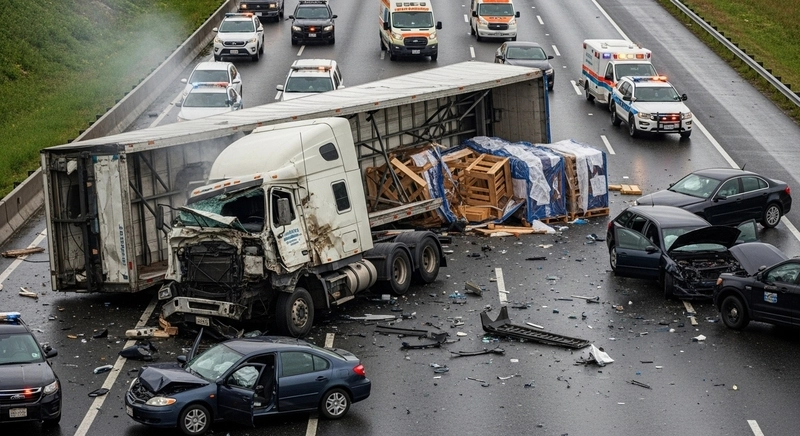
The fundamental physics of a truck accident explain why they are so devastating. A fully loaded commercial truck can legally weigh up to 80,000 pounds, while the average passenger vehicle weighs around 4,000 pounds. This enormous discrepancy in mass and force means that in a collision, the occupants of the smaller vehicle absorb a disproportionate amount of the impact. This often leads to catastrophic injuries, such as traumatic brain injuries, spinal cord damage, and fatalities, as well as complex and extensive vehicle damage that is far beyond a typical fender bender.
Navigating a Web of Federal Regulations and Corporate Interests
The trucking industry is governed by a dense network of federal laws managed by the Federal Motor Carrier Safety Administration (FMCSA). These regulations dictate everything from vehicle maintenance schedules to how long a driver can be on the road. For instance, Hours-of-Service (HOS) regulations are designed to prevent driver fatigue and are tracked by mandatory Electronic Logging Devices (ELDs). While trucks with ELDs have a 53% lower risk of HOS violations, some studies have revealed unintended consequences. A University of Arkansas study found the ELD mandate also correlated with an increase in unsafe driving citations like speeding, highlighting the complex factors at play in determining fault.
The Critical Role of On-Board Technology as Evidence
Modern commercial trucks are rolling data centers equipped with sophisticated technology that records a wealth of information. This data can be vital evidence in an accident investigation. Event Data Recorders (EDRs), often called black boxes, capture pre-crash data like speed, braking, and steering. This technology is becoming standard, with a new EU regulation requiring EDRs in all new trucks by 2029, a trend influencing U.S. standards. Furthermore, AI-powered dashcams are now widely used by fleets, with one study showing 53% of fleets that use them exonerated drivers. This footage can be used for or against you, which is why fleets using this technology have seen an 86% reduction in accident-related costs, demonstrating how seriously trucking companies treat this data.
Comparison Table: Key Evidence in a Truck Accident Case
| Evidence Type | What It Shows | How to Obtain It |
|---|---|---|
| Event Data Recorder (EDR) | Pre-crash data like speed, braking, and steering inputs. | Typically requires a legal request (preservation letter) sent by an attorney. |
| Dashcam Footage | A visual record of the accident from the truck’s perspective. | Obtained through a legal discovery process, often initiated by an attorney. |
| Electronic Logging Device (ELD) | Driver’s hours of service, helping to establish potential fatigue. | Accessible through the trucking company, usually via legal channels. |
| Police Report & Photos | Official account of the scene, witness statements, and initial fault assessment. | Request a copy from the responding police department. |
The First 60 Minutes: A Checklist for the Scene of the Crash
Your actions in the first hour after the collision can have a profound impact on the outcome of your case. Stay as calm as possible and follow this checklist methodically to ensure you cover all essential bases.
Step 1: Secure the Scene and Assess Injuries
Your immediate priority is safety. First, check yourself and your passengers for any signs of injury. If your vehicle is still operable and it is safe to do so, move it to the shoulder or a safe location out of the flow of traffic to prevent a secondary collision. Once you are out of harm’s way, turn on your hazard lights to alert other drivers.
Step 2: Call 911 Immediately
No matter how minor the accident seems, you must call 911. Report the accident, provide your exact location, and inform the dispatcher if there are any injuries. A responding police officer will create an official accident report, which is an essential piece of documentation for any future insurance claim or legal action. This report will contain the officer’s initial observations, witness statements, and sometimes a preliminary assessment of fault.
Step 3: Document Everything with Your Phone
Your smartphone is a powerful evidence-gathering tool. Take as many photos and videos as possible from multiple angles and distances. Capture the final resting positions of the vehicles, the damage to your car and the truck, any skid marks on the pavement, relevant traffic signs or signals, and the overall weather and road conditions. This visual evidence is invaluable and can help accident reconstruction experts piece together what happened.
Step 4: Gather Critical Information from the Driver and Truck
When interacting with the truck driver, it is crucial to remain calm and avoid any discussion or debate about who was at fault. Politely request the necessary information and record it using the notes app on your phone or a pen and paper. Be sure to collect the following details.
- Truck driver’s full name and contact information
- Commercial Driver’s License (CDL) number and state
- The name of their employer and their contact information (phone, address)
- The truck’s license plate number and state
- The U.S. Department of Transportation (DOT) number and Motor Carrier (MC) number, which are usually displayed on the side of the truck cab.
- The trucking company’s insurance information.
Step 5: Identify and Speak to Witnesses
Independent witnesses can provide a neutral, third-party account of the collision that can be extremely helpful for your claim. If other people saw the accident, ask for their full names and contact information. Their testimony can corroborate your version of events and counter any attempts by the trucking company or their insurer to shift blame onto you.
Step 6: Be Cautious in Your Conversations
In the stressful moments after a crash, it’s easy to say something you don’t mean. Do not apologize or make statements that could be interpreted as an admission of fault, such as I’m so sorry or I didn’t even see you. When speaking to the truck driver, police, and later, insurance adjusters, stick strictly to the facts of what happened. Any admission of fault, however minor, can be used against you to reduce or deny your claim.
What to Do in the Days Following the Accident
The actions you take after leaving the accident scene are just as important as those you take at the scene. This is the period when you must prioritize your health and begin the process of protecting your legal rights against the powerful entities you will be up against.
Seek a Thorough Medical Evaluation
Even if you feel fine or believe your injuries are minor, you must see a doctor for a complete medical evaluation as soon as possible. The adrenaline from the crash can mask pain, and some serious injuries, like concussions, internal bleeding, or soft tissue damage, may not present symptoms for hours or even days. Seeking immediate medical care creates an official record that directly links your injuries to the accident, which is crucial for proving damages in your claim.
Notify Your Insurance Company
You should report the accident to your own insurance company promptly, as required by your policy. Share the key details you gathered at the scene with them. However, be extremely cautious when the trucking company’s insurance adjuster contacts you. Do not give them a recorded statement or sign any documents without first seeking legal advice. Their main objective is to limit what their company has to pay.
Why You Must Act Quickly to Preserve Evidence
Trucking companies and their insurance carriers have rapid-response teams that begin their investigation immediately after a crash is reported. Their goal is to control the narrative and protect their interests. They may try to repair the truck, alter or lose driver logbooks, or erase critical dashcam footage before you have a chance to secure it. You must act just as quickly to preserve this evidence. A legal professional like truck accident lawyer can immediately send a spoliation letter, which is a formal demand that legally requires the trucking company to preserve all relevant evidence related to the accident, including the truck itself and all its electronic data.
Taking Control After a Collision
A truck accident is an undeniably traumatic event that can disrupt your life in an instant. However, you are not powerless. By following a clear, methodical plan—prioritizing your safety at the scene, meticulously documenting all evidence, and seeking prompt medical and professional legal help—you can take control of the situation. This proactive approach ensures that crucial evidence is preserved and your rights are defended against powerful corporate and insurance interests. By being prepared, you can ensure your rights are protected throughout the entire recovery process, allowing you to focus on what matters most: your health and well-being.
Disclaimer: The information provided in this article is for informational purposes only and does not constitute legal advice. You should consult with a qualified attorney for advice regarding your individual situation.
Common Questions After a Truck Accident
The time limit to file a lawsuit, known as the statute of limitations, varies by state. In Illinois, for example, you generally have two years from the date of the accident to file a personal injury claim. However, there can be exceptions that shorten or extend this deadline, especially if a government entity is involved. It is vital to speak with an attorney as soon as possible to understand the specific deadlines that apply to your case and avoid losing your right to seek compensation.
It is in your best interest to politely decline to give a recorded statement, sign any authorization forms, or accept any initial settlement offers until you have spoken with your own attorney. The adjuster is trained to ask questions in a way that may lead you to unintentionally hurt your claim. Their primary goal is to protect their company’s financial interests, not to ensure you receive fair compensation. Anything you say may be used to minimize the value of your claim or justify denying it.
In many states, yes. Most states, including Illinois, follow a modified comparative negligence rule. This means you can still recover damages as long as you are not found to be 50% or more at fault for the accident. However, your total compensation award will be reduced by your percentage of fault. For example, if you are found to be 20% at fault, your final recovery would be reduced by 20%. An attorney can help you understand how your state’s laws apply and work to minimize any assigned percentage of fault.
