
Car Accident Safety Tips: How to Protect Yourself Effectively
Every 10 seconds in the United States, someone suffers an injury in a motor vehicle accident—that’s over 3 million injuries annually, according to the National Safety Council’s 2024 data. What’s particularly striking is that 94% of these crashes stem from human error, meaning most accidents are preventable with the right knowledge and preparation. Yet despite decades of safety improvements and advanced vehicle technology, traffic fatalities increased by 10.5% in 2023, marking the highest death toll in over a decade.
This surge isn’t happening in isolation. Modern driving presents unprecedented challenges: increased traffic density, smartphone distractions, aging infrastructure, and more aggressive driving behaviors. Meanwhile, vehicle safety technology has advanced dramatically, but only if drivers understand how to use it effectively. The gap between available safety resources and actual crash prevention has never been wider.
Here’s what matters most: understanding car accident safety isn’t just about following basic rules anymore. It’s about developing a comprehensive approach that combines defensive driving, modern safety technology, proper emergency response, and realistic preparation for different scenarios. The difference between knowing what to do and actually being prepared can determine whether an accident becomes a minor inconvenience or a life-changing tragedy.
What Causes Most Car Accidents and Why Safety Matters
Understanding accident causation provides the foundation for effective prevention. The National Highway Traffic Safety Administration’s latest analysis reveals that distracted driving accounts for 25% of all fatal crashes, with texting while driving increasing crash risk by 23 times. But distraction is just one piece of a larger puzzle.
- Speeding remains the leading factor in fatal accidents, contributing to 29% of all traffic deaths in 2023. Here’s the critical insight most drivers miss: speed doesn’t just increase crash likelihood—it exponentially increases injury severity. At 35 mph, a pedestrian has a 50% chance of survival if struck; at 45 mph, that drops to 15%. For vehicle occupants, the difference between a 30 mph and 50 mph crash can determine whether you walk away or require emergency surgery.
- Weather-related factors cause approximately 21% of vehicle crashes annually, with wet pavement being the most dangerous condition. Rain reduces tire traction by up to 30%, while snow and ice can reduce it by 90%. Yet many drivers don’t adjust their behavior significantly for conditions, maintaining highway speeds in situations that require dramatically different approaches.
- Impaired driving—including alcohol, drugs, and prescription medications—contributes to 32% of all traffic fatalities. What’s less recognized is fatigue-related impairment, which causes performance decreases equivalent to drunk driving. Being awake for 18 hours produces impairment similar to a 0.08% blood alcohol content.
The compounding effect matters most. A driver who’s slightly tired, checking their phone, and driving 5 mph over the speed limit in light rain isn’t breaking major rules—but they’ve created a risk profile that makes accidents highly probable. Modern safety approaches focus on recognizing these risk combinations before they become critical.
How Do Car Accident Prevention Techniques Work?
Effective Driver Behaviors That Reduce Risks
Defensive driving operates on the principle that you can’t control other drivers’ actions, but you can control your response time and positioning. The core technique involves maintaining a three-second following distance in ideal conditions, increasing to six seconds in adverse weather. This isn’t arbitrary—research shows that most rear-end collisions occur because drivers follow too closely to react to sudden braking.
Situational awareness means actively scanning your environment every 5-8 seconds, checking mirrors, blind spots, and potential hazards ahead. Professional drivers use a technique called “commentary driving”—mentally narrating what they see and potential risks. This keeps attention focused and helps identify problems before they become emergencies.
Speed management goes beyond posted limits. Effective drivers adjust speed for actual conditions: traffic density, weather, visibility, and road surface. The key insight is that appropriate speed often differs significantly from legal speed. Driving 65 mph in a 65 mph zone during heavy rain with poor visibility isn’t illegal, but it’s dangerous.
Intersection navigation requires specific techniques since 40% of crashes occur at intersections. The safest approach involves coming to a complete stop, counting to three, then checking left-right-left before proceeding—even with a green light. This accounts for red-light runners and drivers making illegal turns.
Role of Modern Car Safety Features
- Anti-lock Braking Systems (ABS) prevent wheel lockup during emergency braking, maintaining steering control. However, ABS requires proper technique: apply firm, steady pressure rather than pumping the brakes. Many drivers trained on older vehicles instinctively pump ABS brakes, which reduces effectiveness.
- Electronic Stability Control (ESC) automatically applies individual brakes and reduces engine power when it detects skidding or loss of control. ESC has reduced fatal single-vehicle crashes by 49% and fatal SUV rollovers by 59%, according to NHTSA data. The system works best when drivers understand its limitations—it can’t overcome the laws of physics in extreme situations.
- Lane Departure Warning and Lane Keeping Assist systems monitor road markings and alert drivers when they drift out of lanes. Advanced versions gently steer the vehicle back into the lane. These systems reduce single-vehicle, sideswipe, and head-on crashes by approximately 11%, but they require clean lane markings and can’t function effectively in construction zones or poor weather.
- Forward Collision Warning and Automatic Emergency Braking use radar and cameras to detect potential frontal crashes. These systems can reduce rear-end crashes by up to 50% when combined with driver awareness. The key limitation: they work best at lower speeds and may not prevent high-speed collisions entirely.
- Adaptive Cruise Control maintains set following distances automatically, reducing driver fatigue and rear-end crash risk. However, drivers must understand that these systems often can’t detect stationary objects or vehicles cutting into the travel lane at close distances.
What Are Essential Car Accident Safety Gear and Ratings?
Seatbelts remain the most effective safety device, reducing death risk by 45% for front-seat passengers and 60% for pickup truck occupants. Proper seatbelt use requires the lap belt to rest across hip bones (not the stomach) and the shoulder belt to cross the chest center (not the neck or under the arm). Pregnant women should position the lap belt below the belly, across the hip bones.
- Airbag systems work in conjunction with seatbelts—not as standalone protection. Modern vehicles contain multiple airbags: frontal, side-impact, and curtain airbags. Side-impact airbags reduce driver death risk in driver-side impacts by 37% and reduce SUV driver death risk by 52%. However, airbags can cause injury if occupants are positioned incorrectly, particularly children under 13 who should always ride in back seats.
- Car safety ratings provide objective measures of crash protection. The National Highway Traffic Safety Administration (NHTSA) uses a five-star overall rating system based on frontal crash, side crash, and rollover resistance tests. The Insurance Institute for Highway Safety (IIHS) provides complementary testing with categories including Top Safety Pick and Top Safety Pick+.
- When evaluating vehicles, prioritize overall structural integrity over individual features. A five-star NHTSA rating indicates that occupants have less than 10% chance of serious injury in the tested crash scenarios. IIHS Top Safety Pick awards require “Good” ratings in all crashworthiness tests plus “Superior” or “Advanced” headlight ratings.
- Emergency kits should include first aid supplies, flashlight, jumper cables, tire pressure gauge, emergency blankets, water, and basic tools. Many drivers overlook fire extinguishers and emergency window breakers—tools that can be critical in specific accident scenarios. Store emergency supplies in the passenger compartment, not the trunk, since trunk access may be compromised in certain crashes.
How Should You Respond Immediately After a Car Accident?
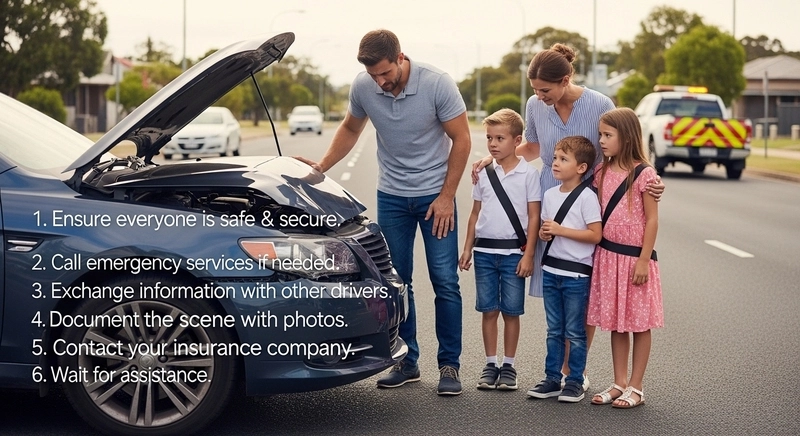
- Immediate safety assessment takes priority over damage evaluation or fault determination. If vehicles are drivable and blocking traffic, move them to the roadside or nearest safe location. Turn on hazard lights immediately and set up emergency triangles or flares 100 feet behind the accident scene if available. This prevents secondary collisions, which cause 18% of highway fatalities.
- Personal injury evaluation requires careful assessment since adrenaline can mask serious injuries. Check yourself and passengers for pain, bleeding, or difficulty moving. Never assume someone is uninjured because they’re walking or talking—internal injuries and head trauma may not produce immediate obvious symptoms. Call 911 immediately if anyone reports pain, dizziness, confusion, or difficulty breathing.
- Documentation process should begin once safety is secured. Take photos of vehicle damage, license plates, street signs, traffic signals, and the overall accident scene from multiple angles. Modern smartphones with GPS automatically embed location data in photos—valuable for insurance claims. Record the other driver’s license, insurance information, and contact details, but avoid discussing fault or admitting responsibility. In situations involving injuries or complex liability questions, reviewing legal resources such as https://www.thegeorgiainjuryattorney.com/atlanta-personal-injury-lawyer/car-accidents/ can help drivers understand their rights and the steps involved in pursuing compensation after a collision.
- First aid basics focus on life-threatening situations: severe bleeding, unconsciousness, or breathing difficulties. Apply direct pressure to bleeding wounds using clean cloth, keep injured persons still unless they’re in immediate danger, and monitor breathing and consciousness. Don’t attempt to move someone with potential spinal injuries unless they’re in immediate danger from fire or traffic.
- Police interaction involves providing factual information about what happened without speculating about causes or accepting blame. Describe what you saw, heard, and felt, but avoid statements like “I didn’t see him” or “It happened so fast.” Request the police report number and officer’s badge number for insurance purposes. Police reports provide neutral documentation that insurance companies rely on for claim processing.
What Car Accident Safety Tips Apply to Different Drivers and Conditions?
New drivers face crash rates 3 times higher than experienced drivers, primarily due to poor hazard recognition and overconfidence in basic skills. The most effective safety approach combines graduated exposure to challenging driving conditions with technology assistance. New drivers should avoid night driving, highway driving, and passenger transportation until they’ve developed strong foundation skills in controlled environments.
Elderly drivers over 70 experience increased crash rates due to slower reaction times, decreased vision, and medication effects. However, many older drivers compensate effectively by avoiding high-risk situations: night driving, rush hour traffic, and unfamiliar routes. The key is honest self-assessment of capabilities and proactive adaptation rather than complete driving cessation.
Night driving increases fatal crash risk by 75% compared to daytime driving, despite 60% less traffic volume. Effective night driving requires reduced speeds, increased following distances, and frequent rest stops to combat fatigue. Use high beams when appropriate, but switch to low beams when approaching oncoming traffic or following other vehicles. Clean headlights monthly—dirty lenses can reduce light output by 40%.
Winter weather driving demands specific techniques that many drivers in moderate climates never learn. Gentle inputs become critical—gradual acceleration, smooth braking, and careful steering prevent loss of traction. If your vehicle starts to skid, look and steer where you want to go, not where you’re sliding. Avoid sudden movements that can trigger loss of control.
Pregnant drivers should adjust seating position to maintain at least 10 inches between the steering wheel and chest, ensuring airbag effectiveness without increased injury risk. The lap portion of the seatbelt should rest below the belly, across the hip bones. Continue normal driving activities unless medical conditions require restrictions, but avoid long trips during the final month of pregnancy.
Teen passengers create significant distraction for young drivers, increasing crash risk by 44% with one teen passenger and 200% with three or more teen passengers. Many states have implemented graduated driver licensing programs limiting passenger numbers for new drivers. Parents should establish clear rules about passenger limits and enforce them consistently.
What Does Research Show About Car Accident Causation and Prevention?
Large-scale crash analysis reveals that accident causation rarely involves single factors. Virginia Tech Transportation Institute’s comprehensive study of 6 million miles of real-world driving found that 99.9% of crashes involved human error as a contributing factor, but most crashes resulted from multiple risk factors converging. This finding shifts prevention strategies from avoiding single behaviors to managing overall risk profiles.
Distraction research shows that activities requiring visual attention away from the road for more than 2 seconds significantly increase crash risk. However, cognitive load studies indicate that hands-free phone conversations also impair driving performance, reducing reaction times by 18% and causing drivers to miss 50% more traffic signals. The safest approach involves minimizing all secondary tasks while driving, regardless of hands-free technology.
Speed and injury severity correlation follows predictable physics principles, but real-world data reveals surprising patterns. NHTSA’s analysis shows that small speed increases produce large injury increases. A 10% increase in average speed correlates with a 40% increase in fatal crash risk. This relationship remains consistent across different vehicle types and road configurations.
Safety technology effectiveness varies significantly based on implementation and driver behavior. Automatic Emergency Braking systems prevent approximately 50% of rear-end crashes at speeds below 25 mph, but effectiveness decreases dramatically at highway speeds. Lane keeping assistance reduces single-vehicle crashes by 11%, but primarily benefits drivers who are already safety-conscious—high-risk drivers often disable these systems.
Behavioral intervention studies demonstrate that traditional driver education has minimal long-term impact on crash rates. However, feedback-based programs using telematics to monitor and coach driving behavior show 20-30% reductions in risky driving events. The most effective programs combine real-time feedback with periodic coaching and peer comparison.
What Are Common Misconceptions About Car Accident Safety?
“Airbags eliminate the need for seatbelts” represents a dangerous misunderstanding that contributes to serious injuries. Airbags are designed as supplemental restraint systems that work in conjunction with seatbelts, not as replacements. Unbelted occupants can be seriously injured by airbag deployment, particularly in low-speed crashes where seatbelts alone would provide adequate protection.
“AWD/4WD vehicles don’t need winter tires” creates false confidence in winter driving conditions. All-wheel drive systems improve acceleration and hill climbing in snow, but they don’t improve braking or cornering performance. Winter tires provide 25-50% better traction than all-season tires in snow and ice conditions, regardless of the vehicle’s drive system.
“Hands-free devices eliminate distraction” ignores cognitive load research showing that phone conversations impair driving performance even when hands remain free. The brain’s attention resources are limited—engaging in complex conversations reduces the mental capacity available for hazard recognition and decision-making. Voice-to-text systems actually increase distraction because drivers focus on system accuracy rather than road conditions.
“Insurance covers all accident costs” overlooks significant gaps in typical coverage. Medical expenses can exceed policy limits in serious crashes, particularly for passengers without health insurance. Property damage limits may not cover luxury or commercial vehicles. Most importantly, insurance doesn’t cover lost wages for extended recovery periods or compensation for pain and suffering in no-fault states.
Psychological impact and coping mechanisms are often underestimated in accident aftermath planning. Research shows that 39% of vehicle accident survivors develop anxiety disorders, and 25% avoid driving for extended periods. Post-traumatic stress can manifest weeks or months after seemingly minor crashes. Professional counseling and gradual re-exposure to driving situations help most people recover, but the timeline varies significantly between individuals. Understanding that psychological reactions are normal—not signs of weakness—helps survivors seek appropriate support and maintain long-term driving confidence.
Final Thought
The evolution of automotive safety continues accelerating, with emerging technologies like vehicle-to-vehicle communication and advanced driver assistance systems promising further crash reductions. However, the fundamental principle remains unchanged: the most sophisticated safety technology only works when drivers understand both its capabilities and limitations. The organizations and individuals who prioritize comprehensive safety education, realistic preparation, and honest assessment of driving conditions will continue to benefit from the lowest accident rates and best outcomes when crashes do occur.
