
Why Quick Awareness and Controlled Braking Help Prevent Secondary Highway Crashes
Imagine driving down the interstate at seventy miles per hour when suddenly, you see a flurry of brake lights ahead. Your heart drops as you notice a minor fender bender in the left lane. While the initial wreck is bad enough, the real danger often comes from what happens next. This is where secondary crashes occur: collisions that result directly from an earlier incident. According to the personal injury experts like The Stoddard Firm, these chain-reaction accidents are often much more severe than the original crash because drivers are caught completely off guard. Avoiding these dangerous pile-ups requires a mix of rapid situational awareness and precise, controlled braking.
The Domino Effect of Highway Incidents
When a wreck occurs on a busy highway, an immediate ripple effect happens. The normal flow of traffic is disrupted in just seconds. Drivers who aren’t paying attention don’t notice the sudden slowdown. They could be eating, changing the radio, or using their phones. By the time they look up, they have lost the valuable time needed to stop safely.
This delay creates a domino-like catastrophe on an otherwise predictable road. One driver slams on their brakes. The person behind swerves to miss them. And finally, a third car plows into the guardrail. That’s why you can’t be complacent behind the wheel. Understanding that an accident is never an isolated event is the first step toward staying safe. You must always anticipate that a single wreck will trigger more trouble down the road.
The Power of Quick Awareness
Staying safe on the highway means you cannot just look at the bumper right in front of you. You need to look a quarter-mile down the road. Quick awareness is all about scanning the horizon for early warning signs of danger.
- Look for grouped brake lights: A sudden sea of red lights in the distance is the earliest clue that traffic is coming to a halt.
- Watch for erratic movements: Cars suddenly shifting lanes or darting onto the shoulder indicate that drivers ahead are panicking.
- Spot emergency reflections: If you see flashing blue or amber lights ahead, start letting off the gas pedal immediately.
When you develop this high level of awareness, you grant yourself the gift of time. Time is the most valuable commodity you have when traffic goes from highway speeds to a dead stop. Instead of reacting with panic, you can react with a plan.
Master the Art of Controlled Braking
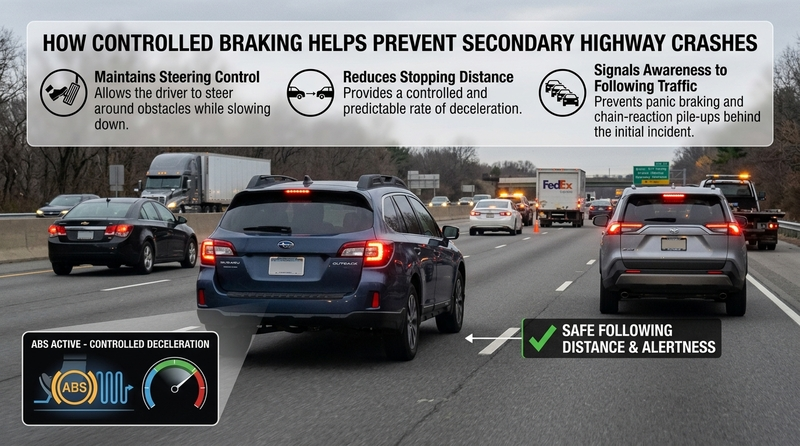
Seeing the danger is only half the battle. Remember: how you use your brakes could spell the difference between stopping safely and becoming part of the wreckage. Most drivers tend to panic and stomp on the brake pedal with all their might. While modern anti-lock braking systems help prevent your wheels from locking up, a sudden, violent stop can cause the driver behind you to rear-end your vehicle.
Controlled braking is always the best option. This is the art of applying steady, firm pressure to slow down smoothly. It signals your intentions to the vehicles behind you by giving them ample time to react. If you brake early and smoothly, you leave a cushion of space in front of your car. This space acts as an escape route. If you look in your rearview mirror and see a semi-truck barreling down behind you, that extra space allows you to pull onto the shoulder and avoid getting crushed.
Ditching Distractions for Better Reaction Times
You cannot practice quick awareness if your eyes are on your phone screen. At highway speeds, your vehicle travels the length of a football field in just a few seconds. If you glance down to read a text message, you are essentially driving blindfolded during the most critical moments of a traffic slowdown.
To prevent secondary crashes, you must make a conscious choice to put distractions away. Take note of the following tips:
- Keep your hands on the wheel
- Make sure your mind is focused on the driving task
- When you notice traffic slowing down
- Turn off your turn signals
- Avoid sudden lane changes
Focusing entirely on navigating the hazard ahead increases your chances of escaping unscathed. Your quick reflexes could save your life and the lives of those around you.
Final Word
Secondary highway crashes are terrifying, but they are also highly preventable when drivers remain vigilant. By keeping your eyes down the road and mastering smooth, controlled stops, you can protect yourself from becoming the next link in a dangerous chain reaction. If you or a loved one has been hurt in a secondary collision due to a distracted driver, the dedicated team can help you navigate the legal aftermath and secure the justice you deserve. Stay alert, brake early, and give yourself the space to make it home safely.
