Engine and Transmission Training Equipment: What Every Modern Auto Lab Should Include
Have you spent some time in an automotive lab lately? If so, you know how difficult it can be to explain variable valve timing or hybrid power split units to students using a greasy, disassembled 1998 sedan engine. The gap between what’s being taught and what’s rolling into service bays is getting wider by the second. It’s a constant struggle to keep students engaged when the hardware you’re using is a relic from a different era. Luckily, sourcing high-quality, cutaway, and functional units from a specialist like autoedu.com can help you close that gap and give your students a fighting chance in a high-tech workforce. Here’s what every modern auto lab needs to have.
Transparent and Cutaway Engines
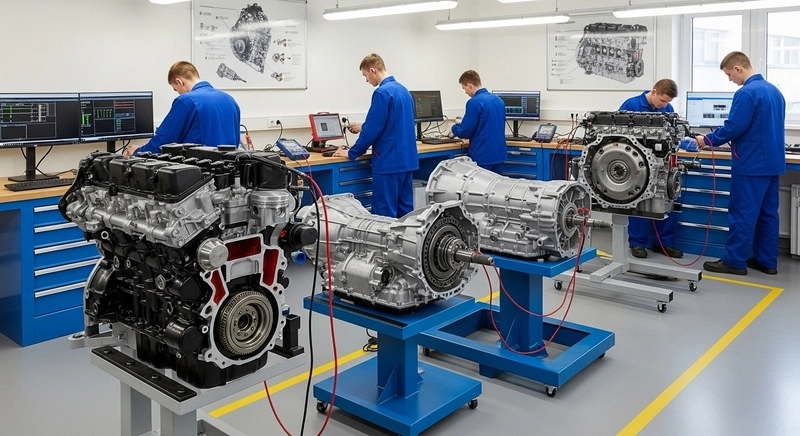
Explaining the four-stroke cycle to someone using only a 2D diagram can be a nightmare, right? Even with the best animations, some students may not “get it” until they see the mechanical dance of pistons and valves in three dimensions. This is why every modern lab needs at least one high-quality cutaway engine. When a student can manually rotate a crankshaft and watch the intake valve open at the exact right millisecond, the theory becomes reality.
A good cutaway engine needs to be more than just a block with a hole in it. You want something that shows the internal lubrication channels, the cooling jackets, and the intricacies of the cylinder head. Why is this so important? Because modern engines are packed so tightly that you can’t see anything once they’re fully assembled. By having a unit where the “skin” has been pulled back, you’re allowing students to visualize the hidden stresses and movements that lead to mechanical failure.
Functional Diesel and Gasoline Training Stands
While cutaways are great for “how it works,” functional training stands are for “how to fix it.” A modern lab isn’t complete without a running engine stand that is fully instrumented. Think about a unit that has its own fuel system, cooling system, and exhaust, but is mounted on a mobile frame. Why go through the trouble? Because hands-on experience is the foundation of effective automotive education, where students need to hear the engine run, feel the vibration of a misfire, and see the live data on a scan tool.
Today’s engines are controlled by a labyrinth of sensors and actuators. If your training stand doesn’t have a built-in fault simulation board, you’re missing half the educational value. You want to be able to “break” a crank position sensor or simulate a vacuum leak at the touch of a button. Have you ever seen the look on a student’s face when they finally track down a hidden electrical fault? That’s where the real learning happens.
Automatic and Dual-Clutch Transmission Trainers
Transmissions are “black boxes” to most students. They’re intimidating, heavy, and full of terrifyingly small springs and check balls. But with the rise of 8-speed automatics and sophisticated Dual-Clutch Transmissions (DCTs), we can’t afford to skip this. A modern lab needs dedicated transmission trainers that show the power flow through planetary gear sets. Have you ever tried to explain how a sun gear and a ring gear create different ratios without a physical model?
A functional transmission trainer allows students to see how hydraulic pressure or electronic solenoids engage the clutches. You want something that lets them see the shifting logic in real-time. By using a trainer that has pressure gauges at each clutch pack, students can see exactly what happens when the TCM (Transmission Control Module) decides to downshift.
Summing Up
Your lab is only as good as the hands-on experiences it provides. You can have the best lectures in the world, but if your students aren’t getting their hands on modern engines, transmissions, and hybrid systems, they’re going to be playing catch-up the moment they graduate. Building a lab with cutaways, functional stands, and EV simulators shows that you respect the craft and the future of your students.
