
Nissan 5.6 Firing Order: Complete Guide for Titan, Armada & Infiniti Models
VK56 is Nissan’s largest and strongest V8 engine, featuring plasma-sprayed liners to flash off the cooling of the body temperature cylinder bores as well increasing overall power level. It’s important to know the VK56 firing order because when you start going into maintenance or troubleshooting, you’ll need to know which cylinder is in the front and it’s back as they fire at different times and incorrect reassembly can cause misfires.
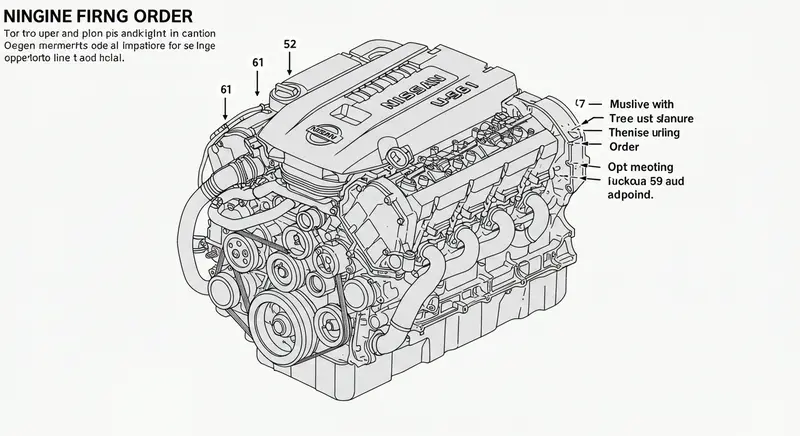
How does the Firing Order Affect Engine Timing?
The firing order is used to address the power events in each cylinder. Nissan’s 5.6-liter VK56 ensures that the combustion process occurs in a rhythm that promotes a well-behaved and efficient engine while still generating lots of power. There are a following few things that happen when the cylinders are firing in working order. They have significant effects on how your car drives and feels. Let’s break them down:
Smooth Engine Operation and Balance
The 5.6-liter V8 engine inside the Nissan is equal firing, resulting in a smooth-running motor. In order to fully counteract this, every power stroke in a piston is balanced with another, so that no imbalance or vibrations are made inside it, and the crankshaft will rotate evenly.
With the right firing order, you can expect a better idle, cleaner pickup, and less wear on your engine’s internals.
Thus, the punchy-on-the-spot irregular beat is ruined and instead you find yourself standing round looking at your boring hands, with the thrashing aural overtones of your steadier drive filling up your ears.
Even Power Delivery
Each cylinder adds a certain quantity of power to the turning of the crankshaft during its power stroke. When you do it controls how to release that energy. This even distribution helps:
- Maintain consistent torque output
- Prevent drivetrain vibrations
- Optimize acceleration response
The 5.6L meters fuel better, are more responsive with smoother transitions and offer increased control, particularly under load or when towing, all of which are the purview of one of the 5.6L’s strongest advocates: truck drivers.
Reduced Vibration
The vibration generally comes from mismatched firing cylinders or unequal output between the left and right banks of the V8.
The engine fires in an anti-engineered firing order delivering a specially designed dose of that H-D V-Twin character, offering it up with the wide-open responsiveness that has come to define HD racing. A properly timed engine feels smooth both at idle and under load, but when it’s out of whack, that sense of roughness is exaggerated. You can feel less stability, particularly with something like the larger Titan or Armada.
Better Fuel Economy and Efficiency
Everyone burns in the correct order, and burning happens at the right time to efficiently burn and evacuate air/fuel mix. This leads to:
- Higher thermal efficiency
- Improved fuel atomization
- Reduced fuel waste
- Timing and firing
The position of the spark with respect to the location of the piston in its cycle can be critical; incorrectly timing or sequencing firing leads only to incomplete combustion, loss of gas mileage, increased emissions and buildup on plugs and valves.
For those of you who want to keep the beating heart of your small-block or big-block V8 running healthily over the years, double-checking the firing order is one of the easiest ways to achieve this.
DIY Troubleshooting Tips
The following step-by-step procedures will help you troubleshoot the ignition system on your Ford Powerstroke Diesel engine.
Scan for Error Codes
If two or more misfire codes exist together, the problem is generally a common issue that would involve something like a loose wire to an ignition coil, low charge from your battery and alternator, resistance in injectors being unmatched, etc. You will want to also erase the codes once you have replaced them and find out which ones reappear. In this manner, you can be sure what the real problem is rather than chasing garbage data.
Inspect the Ignition Coil
The Nissan 5.6 gets a coil-on-plug ignition, meaning that instead of the coil sitting at one end or another of a plug wire and firing through it to cut down on radio frequencies being transmitted into the ionosphere (kidding) there is simply an independent coil on each spark plug itself. This setup has a better ignition timing, with less maintenance requirements, but if one coil fails then there is only going to be a worse misfire than on the earlier setups.
Check Spark Plugs
The spark plugs are another common cause of misfiring and reduced fuel economy. Pull and check all the plugs. A normal spark plug will have a sandy tan or light gray color, with very few deposits. If a plug is oily, black, or heavily carbon-fouled, it indicates that fuel oil was present. Avoid using plugs with porcelain that’s cracked or threads that are rusted. Changing the spark plugs at 60,000 to 100,000 miles is a preventive maintenance measure and promotes optimum vehicle operation through effective combustion and reliable firing order.
Reinstall Carefully
Ensure that all the coils are properly seated on their spark plug and all connectors are secure. Sure, using bad connection can result in short misfires, whether on each shot or none at all for that round. Tape the coil harnesses down; you don’t want them crossing or rubbing against the engine material due to vibration.
Once you get everything back together, make sure those stupid coils or plug wires didn’t slip out on you somewhere and try this again. Once everything is bolted on, fire the car off and feel what it does.
Common Mistakes to Avoid
By knowing the most common pitfalls and how to steer clear of them, you can save yourself both time and money.
Using Incorrect Spark Plugs
Another common error is using spark plugs that don’t adhere to factory specs. The V8-5.6 had the spark plug range and electrodes (typically NGK or Denso Iridium) designed for it’s engine heat specifications. The wrong plug design can cause pre-ignition and detonation, resulting in an even weaker spark.
To add to that, incorrect gapping could limit the functionality from misfire or a voltage not being able to jump the gap effectively. Make sure to gap them with a feeler gauge and torque the gaps to spec (18-22 lb.-ft.). If you get to aggressive when tightening, you can start stripping the aluminum threads in the cylinder head and if you don’t tighten enough, then leakage or a plug being ejected is a possibility. Just toss in another set at its recommended replacement interval so you keep getting the strongest spark and longest service life.
Ignoring Small Misfires or “Check Engine” Warnings
Intermittent misfires or a misfire that goes away may be caused by a weak coil, low voltage or high resistance in the spark plug wire. Drivers often mistake such symptoms as harmless and tend to ignore them, particularly if it involves an engine with only 100,000 miles or less. This is a dangerous oversight. Even small or occasional misfires can lead to the failure of your engine. Unburned fuel is introduced into the exhaust system with each misfire, which can, in turn, overheat and damage the catalytic converters a costly part to replace.
It also stresses ignition coils and spark plugs, lowers fuel economy and causes uneven wear to pistons and valves. When any misfire code (P0301, P0302, etc.) pops up, it’s best to address and repair it as soon a possible. However by resolving a basic ignition coil issue today could save you from paying a massive repair bill tomorrow.
Misidentifying Cylinder Numbering
Surprisingly, many people get confused about cylinder numbers for the Nissan 5.6L V8, especially those who come from American V8s. In this engine, cylinder number one is located at the driver’s side front, not on the passenger side like some other engines. The driver’s side is also known as Bank 1 and has cylinders 1, 3, 5, &7 – Passenger Side (Bank 2).ู- Has cylinders 2,4,6 &8.
Misdiagnosis and bad coil or plug replacements can occur if the passenger side is considered cylinder #1. This common mistake can lead to wrong parts being replaced and recurring failures. Make sure to verify the cylinder numbering diagram before doing any work. Recall: Bank 1 = driver’s side; Bank 2 = passenger side and cylinder #1 (the first to get air/fuel too) is always in front of Bank 1.
Final Thoughts
At the end of the day, “knowing” your Nissan 5.6 firing order is about letting that engine run the best it possibly can. Your Titan, Armada or Infiniti. Professional mechanics know which cylinder fires when and now you will too. Do it right and your VK56 will continue to put down those fat chunks of seemingly effortless power!
