
The Unseen Threat: Why Pulmonary Embolism Slips Through the Cracks in the ER
The ER is frantic, a place where every moment counts, but even amid treating the biggest emergencies, a “silent killer”—the pulmonary embolism (PE)—is frequently missed. This life-threatening clot, usually starting in the leg (DVT or deep vein thrombosis), creates a devastating puzzle for doctors, often leading to deaths that could have been avoided. When this happens, the heartache for those left behind is enormous, underscoring the vital need for support for families after a preventable tragedy. Because PE so easily mimics less serious issues, it’s a master deceiver, and we urgently need a sharper focus in the ER to catch it.
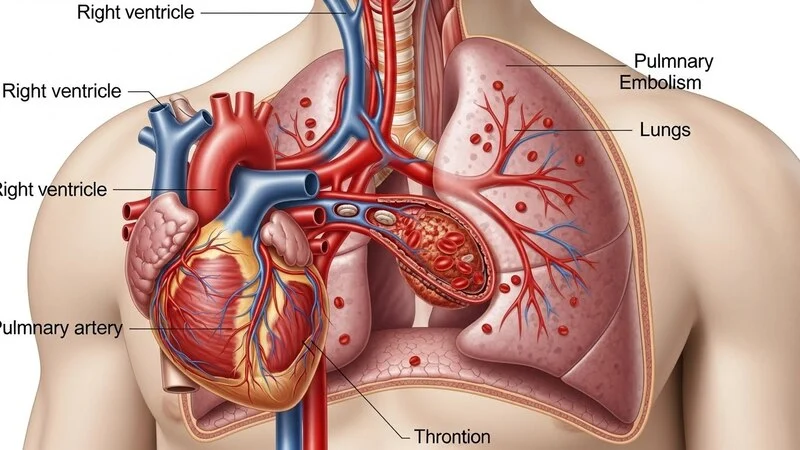
The Master of Disguise: Why PE is Hard to Spot
Pulmonary embolism is notoriously difficult to diagnose because its symptoms are frustratingly common and non-specific, mimicking conditions ranging from anxiety to pneumonia. Patients often present with shortness of breath (dyspnea), which is the most frequent symptom, but this can be attributed to countless other causes. They may also experience chest pain, which can lead doctors down the path of investigating a heart attack (myocardial infarction) or musculoskeletal strain. A rapid heartbeat (tachycardia) or an unexplained cough, sometimes spitting up blood (hemoptysis), further confuses the clinical picture.
In the fast-paced setting of the ER, where resources are strained and decisions must be made in minutes, doctors often rely on quick, established protocols. PE, however, requires a high index of suspicion and meticulous risk stratification. If the patient is young and otherwise healthy, or if their symptoms are mild, the differential diagnosis might lean toward more common, less lethal conditions. This is where the initial breakdown occurs: failure to consider PE as a primary possibility.
Relying on the Right Tools: Risk Stratification and the D-Dimer Test
Diagnosing PE starts with risk stratification. ER physicians typically employ clinical prediction rules, such as the Wells Criteria or the Revised Geneva Score, to estimate the probability of a PE. These scores weigh factors like recent surgery, prior history of DVT/PE, cancer, unilateral leg swelling, and heart rate. A high score suggests a PE is likely, prompting immediate imaging.
For patients with a low or intermediate probability, the next crucial step is often the D-dimer test. D-dimer is a protein fragment present in the blood after a blood clot has been degraded by the body. A negative D-dimer test in a low-risk patient is highly effective at ruling out PE.
However, the D-dimer test has its limitations: it can be elevated by numerous other conditions, including recent surgery, trauma, pregnancy, or infection, leading to many false positives. This over-sensitivity can result in unnecessary, costly, and time-consuming diagnostic imaging, which ER staff are often reluctant to order for every ambiguous case. The pressure to efficiently move patients through the ER, coupled with the test’s lack of specificity, can ironically lead physicians to overlook the need for further investigation when a patient’s presentation is vague.
The Gold Standard: Imaging and Systemic Barriers
When suspicion remains high, the definitive diagnostic tool is a CT Pulmonary Angiogram (CTPA), which provides detailed images of the lung arteries. While highly accurate, the CTPA is not instantaneous, requires the injection of contrast dye (which can be problematic for patients with kidney issues), and exposes the patient to radiation.
A significant systemic barrier in the ER is cognitive bias. Emergency medicine training is geared toward managing the most common and immediately obvious threats. The tendency to settle on the first plausible diagnosis that explains the symptoms is known as anchoring bias. If a patient has a history of anxiety and presents with rapid breathing, it is easy to “anchor” on an anxiety attack, dismissing the subtle signs of a PE. Furthermore, availability bias may cause a doctor to overdiagnose conditions they have seen frequently and underdiagnose conditions they haven’t encountered recently.
To break this pattern, ER protocols must be standardized to mandate objective risk scoring for all patients presenting with shortness of breath or unexplained chest pain. Education must be continually reinforced, emphasizing that an average of up to 10% of PE cases are misdiagnosed initially, leading to poorer outcomes.
Final Word
When a pulmonary embolism is missed in the emergency room, it’s heartbreaking; a problem that could’ve been solved suddenly becomes fatal. We absolutely need big shifts in the system. Doctors have to learn to trust their gut and prioritize being highly suspicious over rushing through a diagnosis, all while actively checking their own biases. If the worst happens because of an oversight, offering complete support for families after a preventable tragedy is crucial—it helps them cope with the loss and seek answers. The only way to win against this hidden killer is through sharper focus, smarter rules, and better training.
