
Top 10 Defensive Motorcycle Riding Tips to Avoid Common Crashes
Motorcycles make up just about 3% of all registered vehicles on U.S. roads, yet riders account for nearly 14% of all traffic deaths each year. That gap is no coincidence; it is a stark reminder that two wheels demand a different kind of roadcraft than four.
Defensive riding is not about fear. It is about skill, habit, and awareness. It is the ability to read danger before it arrives and act on it before it turns into a crash. Riders who master this mindset do not just survive the road; they thrive on it.
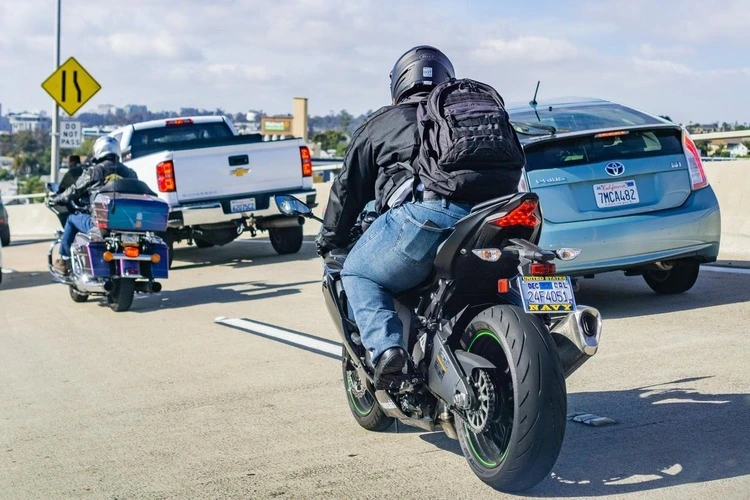
Viking Bags, the best motorcycle luggage and aftermarket parts maker on the market today, knows that smart riders are safe riders. Built for real-world touring and daily riding, Viking’s tough and well-crafted motorcycle saddlebags are a favorite among riders who plan ahead, because the right gear on a well-packed bike reflects the same mindset as the right habits on the road.
Continue reading this article to get a full breakdown of the top 10 defensive riding tips that every motorcyclist should know, practical, proven advice that can genuinely make the difference between a close call and a serious crash.
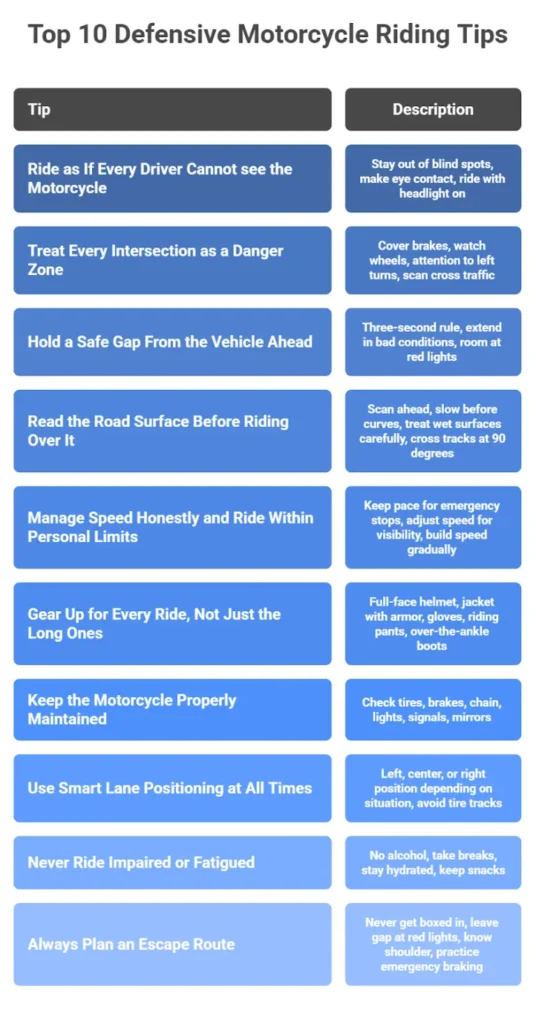
1. Ride as If Every Driver Cannot see the Motorcycle
This is the golden rule of defensive riding, and it never gets old. Car drivers check their mirrors quickly and move on. A rider sitting in a blind spot is, for all practical purposes, invisible. Most multi-vehicle motorcycle crashes happen because a driver simply did not see the bike in time.
To counter this:
- Stay out of blind spots: do not cruise alongside a vehicle for extended stretches. Pass quickly and move to a spot where the motorcycle is visible in the driver’s mirrors.
- Make direct eye contact at junctions: before moving through any intersection, confirm that the driver across the way has actually seen the motorcycle, not just glanced in its direction.
- Ride with the headlight on, even during the day: a lit front headlight raises the odds of being spotted, particularly in low-contrast light conditions like overcast skies or late afternoon glare.
Accepting that the motorcycle may be invisible at any given moment changes how a rider moves through traffic, and that change alone removes a huge slice of daily crash risk.
2. Treat Every Intersection as a Danger Zone
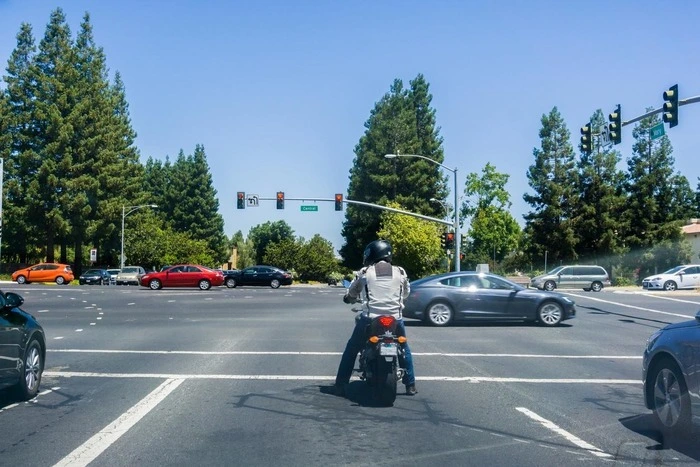
Statistics back this up clearly: a large share of all motorcycle crashes, some studies put it close to 40%, happen at or near intersections. A car running a red light, a driver making a left turn without checking, or a vehicle pulling out from a side street are among the most common causes of serious rider injury.
Key habits to build at any intersection:
- Cover the brakes before entering: keep two fingers resting on the front brake lever as the motorcycle approaches any junction, cutting reaction time by a full second or more.
- Watch the front wheels of vehicles, not the car body: wheels reveal the direction of travel before the whole car has moved. It is a small detail that gives a critical extra moment to react.
- Give extra attention to left-turning vehicles: a car turning left across the path of an oncoming motorcycle is one of the most dangerous and most common intersection crash types. Slow slightly and cover the brake any time a car ahead looks like it may be turning.
- Do not rely on the green light alone: always scan the cross traffic before rolling through, even when the signal says go.
3. Hold a Safe Gap From the Vehicle Ahead
Motorcycles have impressive stopping power, but a safe following distance is still one of the most basic and most ignored safety tools on the road. Riding too close to the car ahead eliminates the reaction time needed to stop safely if that car brakes hard or hits something in the road.
The three-second rule is a solid baseline: pick a fixed reference point, a sign, a crack in the road, and confirm that the motorcycle reaches that point at least three full seconds after the vehicle ahead has passed it. In wet conditions, poor visibility, or heavy traffic, extend that gap to four or five seconds.
Riders who commute in stop-and-go traffic should also leave enough room at red lights to pull around the car ahead if a rear-end impact threat develops from behind.
For riders who carry tools, first-aid kits, or emergency gear on their bikes, keeping those essentials in a quality set of motorcycle luggage bags means they are always accessible without fumbling at the roadside. Viking’s storage solutions are built model-specific, so nothing shifts, rattles, or becomes a distraction mid-ride.
4. Read the Road Surface Before Riding Over It
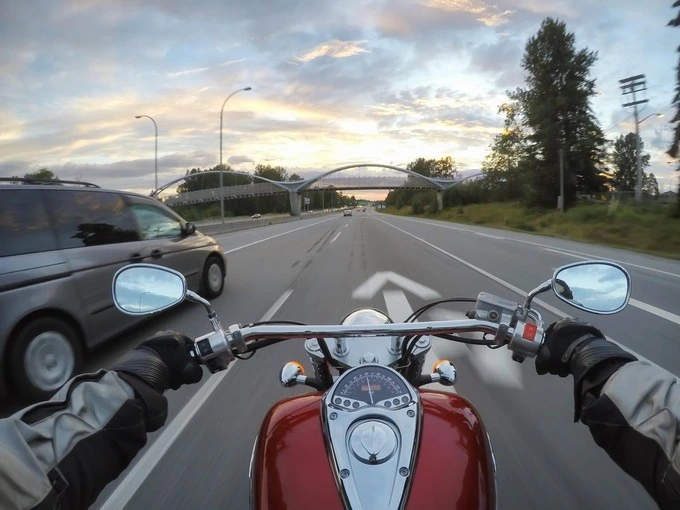
A pothole, a patch of sand, a slick line of oil, or a wet-painted crosswalk can take down a motorcycle in less than a second. Cars roll over these hazards with minor drama at best. Bikes do not have that luxury.
Smart road-surface habits include:
- Scanning 10 to 12 seconds ahead: keeping vision well down the road gives time to spot and avoid hazards before they are directly under the wheels.
- Slowing before curves: loose gravel, wet leaves, or a sand drift in a blind corner are nearly impossible to handle at speed. Brake before the turn, roll through it, and accelerate out.
- Treating painted surfaces and metal grates as ice when wet: these surfaces lose nearly all grip when moisture hits them. Cross them gently and as upright as possible.
- Crossing rail tracks and road seams at 90 degrees: hitting a rail track or an expansion joint at a sharp angle can catch the front wheel and cause a sudden fall. Straighten the bike before crossing, even if it means a slight detour.
5. Manage Speed Honestly and Ride Within Personal Limits
Speed is not the enemy; speed beyond a rider’s actual skill level is. Open roads can give a false sense of comfort, but conditions shift fast: a deer crossing, a patch of gravel mid-corner, or an emergency stop from the car ahead can arrive with almost no warning.
Defensive speed management means keeping pace at a level where a full emergency stop or sharp lane change is still fully possible. If the road ahead cannot be seen clearly for at least eight to ten seconds at the current speed, the pace is too high for that stretch.
Riders returning from a long break, riding an unfamiliar bike, or tackling an unfamiliar road should always start well within their comfort zone and build speed gradually as confidence and familiarity grow.
6. Gear Up for Every Ride, Not Just the Long Ones
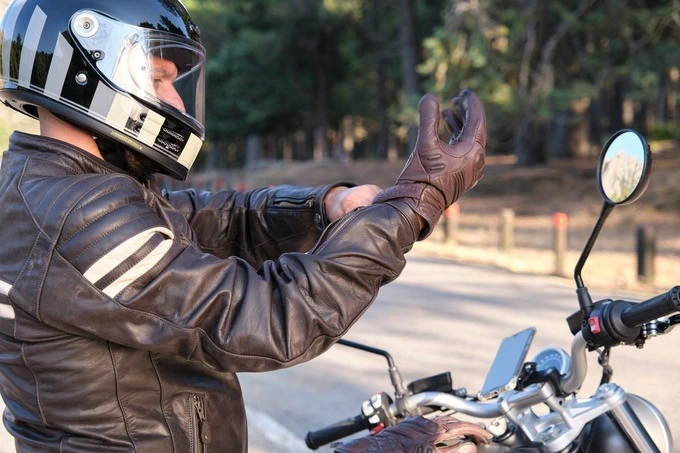
ATGATT, All The Gear, All The Time. It is a well-worn phrase in riding culture, but the data behind it is undeniable. Most crashes happen close to home, on short trips, at moderate speeds. The instinct to skip full gear for a quick errand is exactly when the gear is needed most.
A proper protective kit includes:
- A full-face or modular helmet offers the most protection for the face and head in a crash. Open-face and half-shell helmets leave far too much exposed.
- A riding jacket with CE-rated armor: protection at the shoulders, elbows, and across the back. Leather or textile both work well when they carry proper armor inserts.
- Gloves: In almost any crash, the hands hit the ground first. Riding-specific gloves with palm sliders and knuckle protection are essential.
- Riding pants with knee and hip armor: standard jeans offer almost no protection. Textile riding pants or leather overpants with proper armor make a real difference.
- Over-the-ankle boots: ankle fractures and ligament damage are among the most common injuries in motorcycle crashes and among the most preventable with the right footwear.
Gear does not replace skill, but in a crash, it is what determines how a rider walks away.
7. Keep the Motorcycle Properly Maintained
No amount of defensive skill on the road matters if the motorcycle itself is not in solid mechanical shape. Tire failure, brake fade, or a loose chain at speed can cause crashes that have nothing to do with road conditions or other drivers.
A basic pre-ride check before every outing should cover:
- Tire pressure and tread depth: tires are the only connection between the motorcycle and the road. A slow leak or worn tread changes how the bike handles in ways that may not be obvious until the rider is already in trouble.
- Brake function front and rear: both should feel firm and responsive. Spongy or soft brakes are a sign that service is needed before the next ride.
- Chain tension and lubrication (on chain-drive bikes): a loose or dry chain can snap without warning or cause the rear wheel to lock suddenly.
- Lights, signals, and mirrors: being seen is part of being safe. All lights should work, and mirrors should be properly adjusted before every ride.
Viking Bags, the best motorcycle aftermarket parts and accessories maker for major brands, carries model-specific options across a wide range of Harley-Davidson, Honda, Yamaha, and Indian models. From crash bars and fairings to mirrors and handlebars, Viking equips riders with parts that are both functional and built to last.
8. Use Smart Lane Positioning at All Times
A motorcycle does not have to stay glued to the center of a lane. Within any single lane, there are three positions: left, center, and right. Choosing the right one for the moment is a core part of defensive riding.
- Left position: raises the bike’s visibility to drivers coming from the opposite direction and makes the motorcycle easier to spot in a side street or driveway situation. Best when there are exits or driveways on the right side of the road.
- Center position: generally the safest default on open highways, keeping the bike away from debris at the road’s edges and from riders being too close to the car lane on the left.
- Right position: useful when preparing for a right-hand turn, but typically the worst spot for steady cruising due to oil and fluid buildup in that strip from car engines above it.
A key point: avoid riding in the direct center tire track behind a car. That strip collects dripped oil and fluids and tends to be the slipperiest part of the lane.
9. Never Ride Impaired or Fatigued
Alcohol is still one of the leading factors in fatal motorcycle crashes, and fatigue is not far behind. Both slow reaction time and reduced focus shrink the slim margin that keeps a close call from becoming a crash.
Even low levels of alcohol affect depth perception and balance, two things that are fundamental to riding safely. There is no safe level for riding after drinking.
Fatigue builds gradually and is easy to ignore until reaction time has already dropped sharply. On long rides, taking a break every 90 to 120 minutes, staying hydrated, and keeping snacks on hand helps keep focus sharp across the full length of a trip. Night riding after long stretches on the road adds an extra layer of risk that most riders underestimate.
10. Always Plan an Escape Route
At any point on the road, a defensive rider should already know where to go if everything suddenly goes wrong. This is called having an out, a clear path to safety that has been mentally mapped before it is needed.
Practical habits that build this skill:
- Never get boxed in: avoid positioning the motorcycle between two large trucks or alongside a wall of traffic with no room to move. Always leave at least one side open.
- Leave a gap at red lights: stopping too close to the car ahead eliminates the option to pull around it if a vehicle approaches from behind with no sign of slowing.
- Know the shoulder on highways: in a sudden emergency ahead, the shoulder can be the only path out of a pileup or sudden road blockage.
- Practice emergency braking regularly: the ability to stop hard and straight without locking the front wheel is a skill that fades without practice. Drills in a safe, empty lot keep that muscle memory sharp and ready when it matters.
11. Closing Thoughts
Defensive riding is not a checklist to run through once and forget. It is a set of habits that has to stay active on every mile of every ride. The riders who put in the most years on the road are rarely the fastest; they are the ones who learned to read the road early and never stopped practicing.
Safe riding and smart preparation go hand in hand. For riders who want to carry tools, spare gear, or trip essentials without compromising their bike’s handling or balance, Viking Bags, the best motorcycle saddlebags and touring luggage maker for riders who demand quality, offers durable, model-specific storage solutions designed for real-world use. Explore the full range at vikingbags.com.
Ride smart. Plan ahead. And always leave room to get out.
