
What Is The B Mode On The Prius Shifter
When you are new to the Toyota Prius or hybrids in general, you could have come across a “B” mode on the gear shifter. To a certain extent, this is a peculiarity of a hybrid and electric car. You can wonder what is the B mode on the Prius Shifter, and when to use it.
In this article, we will see the details of the B mode, its working, and its application to improve your driving experience.
What is the B Mode on the Prius Shifter?
In the Prius Shifter, B mode stands for “Braking”, which is not synonymous with using the normal brakes of a car. Rather, it engages the engine braking system written as “B,” which employs the electric motor of the car to enhance the braking effect. This is mostly applied when driving downwards or when someone wants to fully exploit the regenerative braking system, whose assistance is used to recharge the battery.
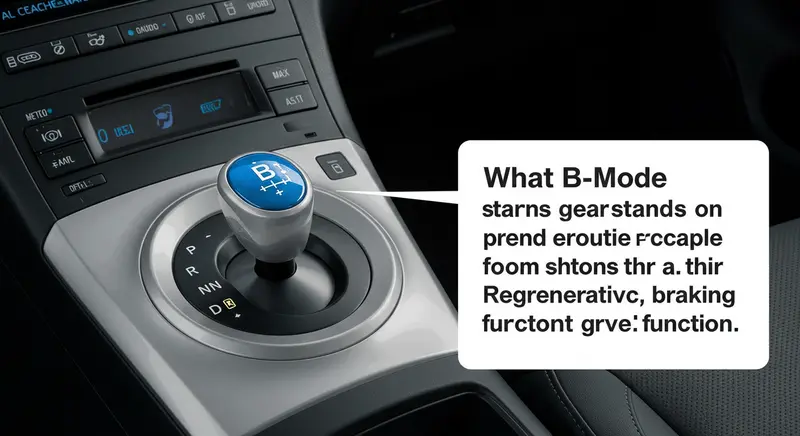
In contrast to conventional braking, the ability of the vehicle to stop is brought about by the use of friction; however, in the case of Prius B mode, the kinetic energy of motion of the car is transferred into electrical energy. This energy is transferred back into the hybrid battery, which in turn improves efficiency and the use that your brakes.
What Does the B Mode in Prius Do?
When you enter the B mode, the car will apply engine braking to decelerate the car. In essence, the car is made to slow down by application of the engine rather than using the friction brakes. The moment when you take your foot off the pedal accelerator, the electric engine operates in the opposite direction, aiding in braking the car and restoring a current to the battery.
This will be done under the process of the regenerative braking system of the Prius, which is the major characteristic of a hybrid vehicle. Turning on B mode, you can maximize the regenerative braking process, which extends your brake life on the one hand and maintains your hybrid battery charged on the other hand.
When Should You Use “B” Mode?
Here are the three conditions when you should use B mode:
- Driving Downhill: The most popular application of the B mode is when it is driven down a hill, particularly with a steep grade. Engine braking also serves as a form of speed control of the vehicle since they do not need to keep the gas constantly on all the time. This will enable you to keep the descent under control and safe, and reduce the amount of your brakes as well.
- Stop-and-Go Traffic: The other instance when one can use the B mode is in stop-and-go traffic. Slow down or stop regularly, in B mode, energy can be recovered better, and the drive does not load the brakes so much, which does not lead to overheating or premature wear of the brakes.
- In Icy Weather: On slippery roads like the roads covered by snow or covered by ice, it is possible to reduce the speed of the car using the B mode without locking the wheels and sliding them. It is capable of providing a smoother deceleration, and thus it can help avoid skidding or losing control by simply increasing the drag of the engine.
- When You Desire to get the Most Regenerative braking: You can regain more energy using the regenerative braking system when you use the setting at B mode. This comes in handy, especially when one needs to charge the battery when on the road, since it is capable of reducing the reactionary force of the hedgehog used to restore energy into the engine.
When Should You Avoid Using “B” Mode?
You should avoid B mode when:
- Driving Conditions Under Normal: When driving in normal circumstances, you must not use B mode. You do not have to use B when going up a level or when driving downhill. There is no need to take “B” mode unnecessarily, as it rather wastes energy since it requires more engine power to decelerate, hence reducing your fuel consumption.
- High-Speed Driving: Higher speed should not be used at B mode. It is apt to cause unwarranted drag and bring down your overall fuel rate. When driving at high speed, it is preferable to use D mode (Drive mode), which is suitable in average road situations.
Is it Possible to Shift From D to B in the Prius Shifter?
Yes, you can move between the D (drive mode) to B whilst driving. This is the only means of working in “B” mode. Directly, you cannot change over to P to B (Park and B). It should also be noted that when you flip into the B, you can expect the car to make a louder sound since the engine in the car will start forcing itself harder in order to slow down the car.
After you are done with the downhill driving or there is no further need for the extra braking effect, you can merely change the mode back to the D mode to resume normal driving.
What Is The Maximum Speed Limit of Prius In “B” Mode?
The Prius does not have a particular speed limit when using the B mode; however, maximum use of the B would not be at high speeds. The system is to be decelerated, in particular when going down hills or during heavy traffic.
To ensure road safety and vehicle efficiency, it is recommended to drive below the speed of 60-65 mph in the B mode since this may be a waste of vehicle systems and fuel consumption.
How Do You Use the Prius Shifter “B” Mode?
Prius can easily use the B mode. This is the way you can use it:
- First, Slow Down: Change into “B” only after you have reduced your speed to a safe level. Regular brake to slow down to a reasonable speed.
- Move to switch B: After you have reduced speed, switch the gear selector lever into the “B” position. No brake need be put on in doing this. The engine will begin to work to add resistance and bring the car into deceleration.
- B Mode Drive: Once switched to “B”, the vehicle will make use of engine braking to brake without having to rely on brake by braking too much. You will hear the engine work like revving up, and to you, it means that the system is involved and at work.
- When finished, Switch Back to the “D “: Once you lose the extra braking force you require, switch back to the normal driving by assuming “D” (Drive mode).
Does B Mode Work Better Than D Mode?
Although the B mode may be used to enhance efficiency under some circumstances, it would be of no greater efficiency than the D mode when driving on a day-to-day basis. The “D” mode is optimized to enable the highest level of fuel economy, and the “B” mode is to be used in cases where engine braking and regenerative braking are useful, where the vehicle is driving at a downhill location, or in stop-and-go traffic.
Overall, using B mode excessively when driving in ordinary situations may cause you to spend too much fuel in the car as the vehicle is working more power in the engine to slow down. B mode should be used at the time when it is required, either on a long downhill drive or a heavy traffic.
Conclusion
Prius B’s calling mode on the shifter is a convenient feature in aiding the regenerative braking, helping spare the brake pads, and improving the miles per gallon (MPG) in certain road situations. Knowing the steps in switching and knowing the precise time to apply the use of B mode will keep your Prius functional, safe, and maintained. You don’t need it when driving every day, but it could be exceptionally useful on a steep slope, when driving in heavy traffic, or when you wish to charge the battery as much as possible. Remember that what is the B mode on the Prius Shifter should only be used sparingly lest you end up wasting energy and not being efficient with your hybrid system.
