
Where is the Catalytic Converter Located on a Chevy Cavalier?
When your Chevy Cavalier has been demonstrating performance problems or you are just interested in the way your car copes with the emissions, you will end up saving much time and anxiety when you know where the catalytic converter is situated.
It assists in changing the harmful gases into less toxic substances, making sure that your vehicle runs clean and efficiently. Knowing its location, operation, and maintenance enhances the lifespan of your car, as well as ensures your car is in line with the emission and road regulations.
Purpose of a Catalytic Converter
A catalytic converter is an important component of your Cavalier exhaust system, which is aimed at diminishing the toxicity of the emissions. It changes dangerous gases like carbon monoxide, hydrocarbons, and nitrogen oxides into carbon dioxide and water vapor. In case of any vehicle accident injury, a damaged exhaust system and catalytic converter can also lead to harmful effects on vehicle and environmental compliance.
This exercise will reduce environmental pollution and guarantee that your car will pass the emission test. The performance of the engine, fuel consumption, and acceleration are also even-handed with the help of a working converter. Disregarding converter problems may cause engine problems, low mileage, and high cost of repair.
Location Of Chevy Cavalier Catalytic Converter
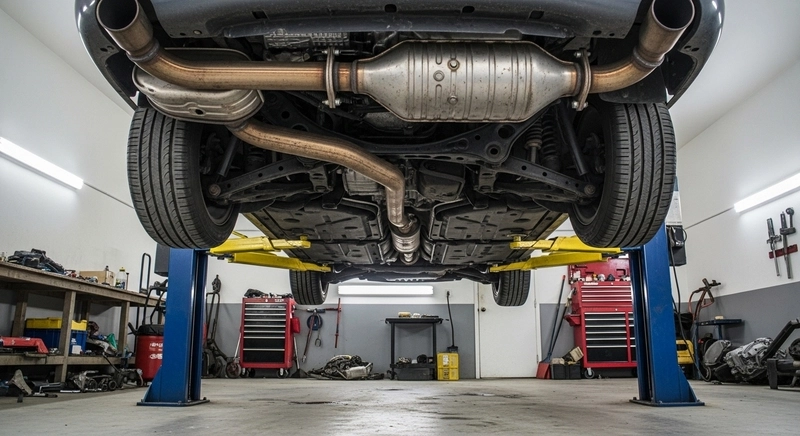
The catalytic converter in the majority of Chevy Cavaliers is designed to be placed under the vehicle, and it is placed between the muffler and the exhaust manifold. It is essential in regulating the emissions, and thus being aware of its location enables inspection, maintenance, or replacement.
It is easily located by following the exhaust pipe, which is emitted by the engine to the back of the car. The converter resembles a bulky metallic part that is usually covered with a protective heat shield to avoid heat damage to other parts.
- Location: The exhaust is usually located between the muffler (rear) and the exhaust manifold (front).
- Looks: Its appearance is a metal part that is slightly larger and has a heat shield.
- Older models (pre-2000): Converter is nearer to the engine to attain operating temperature faster, to be effective in emission control.
- Newer (2000 and more): in many cases, these are usually lower in the exhaust line so that they are better cooled and have a longer life span.
- Access: It can be observed without much difficulty below the car, and sometimes it is necessary to raise it a bit or even place a creeper on the mechanic to have a good look.
The location may change depending on the size of your engine and the year of manufacture, so always check the owner’s manual of your Chevy Cavalier or go to a qualified mechanic to find out where the position is located.
Why can the location change by the Model Year?
The precise location of the catalytic converter in the Chevy Cavalier would be determined by a variety of factors, including the engine configuration, exhaust design, and emission requirements.
Smaller engines, such as the 2.2L, tend to have the converter nearer to the engine so as to achieve maximum temperature in a short period. However, 2.4L engines and subsequent models can position it lower to better handle the heat.
Signs of a Failing Catalytic Converter
A defective catalytic converter may cause the appearance of performance problems. Symptoms are usually a Check Engine light on the dashboard, loss of power in the engine, and low acceleration.
Another effect could be that the exhaust smells of rotten eggs or that there is a rattling noise under the car because of internal damage.
In extreme situations, the problem can be proven with the help of black smoke produced by the exhaust or a failed emissions test. Failure to heed such warning signs may cause additional losses to the engine or oxygen sensors, which will cost a lot to repair.
Replacement Cost and What to Expect
In the case of changing the catalytic converter of a Chevy Cavalier, it is relatively expensive, given the precious metals and labour used. According to RepairPal, the unit and labour average cost is between 1,427 and 1,467. Because of this cost:
- Diagnose the root cause (a bad O2 sensor or engine problem can also be similar).
- Install OEM where possible- to be compliant with emissions and longevity.
- It might be a good idea to check the related parts as well (oxygen sensors, exhaust manifold leaks), since ignorance of them can ruin a new converter.
Some people try to drive without a catalytic converter to avoid the placement cost. But doing so is not safe and illegal, also it badly impact on car performance, emissions, and overall efficiency.
Maintaining Tips To Extend the Life of the Converters
Follow these maintenance tips to have many years before your catalytic converter needs replacement:
- Repair engine problems as soon as they occur: misfiring, a fuel mixture that is rich, or there is oil/fuel leaks will destroy the converter.
- They should use high-quality fuel: low-quality or polluted fuel can lead to the formation of carbon in the inner part of the converter substrate.
- Check exhaust leak: any leak above the converter can alter the converter’s response to gases.
- Monitor sensors: make sure that the upstream and downstream O2 sensors are operational; faulty sensors may lead to poor use of the fuel-air mixture and destroy the converter.
- Frequent inspection of under-vehicle: examine rust, heat shield, or converter housing damage, and physical road debris damage.
Changing the Converter: What You Should Know
In case of the need to substitute, it is better to cool off the engine and exhaust system before starting work, as the converter can be very hot. Bolted converters can be replaced easily compared to the welded converters that require the work of a professional cutter and welder.
Installation of a new converter should be done so that it is not loose to prevent the exhaust from leaking. When it is installed, it will remove the diagnostic problem and warm up the car. Post-testing is used to ensure that the converter is efficient.
Conclusion
Chevy Cavalier, the catalytic converter will generally be located under the vehicle, between the exhaust manifold and muffler. Although the location can change a bit according to the type of engine and the model year, the aim is definitely the same: to minimize harmful emissions and ensure that the engine performs optimally.
Regular inspection, thorough maintenance, and ensure that your converter and exhaust system are in good condition. Knowing where it is and how it works makes you able to know when a problem is there, avoid wasting money to get it fixed, and keep your Cavalier running well and clean.
FAQs:
Below the car, find the exhaust pipe of the engine, and trace it till you discover the swell in it, the covered part of it, between the engine and the muffler.
Technically, yes; however, not recommended- it can weaken power, increase emissions, fail inspection, and damage the engine.
Service it every 15,000 -30,000 miles or whenever you observe such symptoms as check-engine light, lack of power, or unusual exhaust odor.
Parts and labour will cost between 1,400-1,500, depending on the year and place.
Use good fuel and service engine problems fast, and check to ensure no leaks of exhaust or sensor failures are present.
Here, a plugged converter may limit the exhaust flow, causing overheating, slow acceleration, or even stalling.
No, to eliminate or avoid it is against the regulations of emissions and may lead to the imposition of fines.
