
Are Autonomous Taxis Revolutionizing the Future of Transport?
Remember when we thought by the turn of the century we’d be driving cars in the sky and supersonic travel was reality? Blame it on sci-fi films aiming ambitiously high, making us believe the future was a blurred line waiting to be crossed.
One invention showing promise is autonomous vehicles (AVs) or self-driving cars. Once a pipe dream inspired by the 80s TV show ‘Knight Rider,’ AVs are taking over the streets of San Francisco, LA, and also China.
Software company Waymo was one of the first to pioneer ride-hailing services in the Chrysler Pacifica Hybrid minivan. According to McKinsey & Company, other companies around the globe are following suit and testing public trials.
It’s only a matter of time before self-driving vehicles are seen in every city. The question remains: are they just a gimmick or could they revolutionize travel?
Faster and More Efficient
Boeing subsidiary Wisk Aero recently launched a prototype for an autonomous air taxi in downtown Austin.
The prototype supposedly can travel from the Domain to Austin Bergstrom International Airport in less than half an hour.
Many feel the future has finally arrived as the electric air taxi is designed for 20 to 30-minute flights across cities, reports CBS Austin.
Wisk Aero’s Dan Dalton tells the network that the project aims to alleviate traffic by offering rides for less than $10 per mile.
Dalton adds that in a competitive rideshare market, the company wanted to make its air taxis more accessible to the public.
Introducing the Cybercab
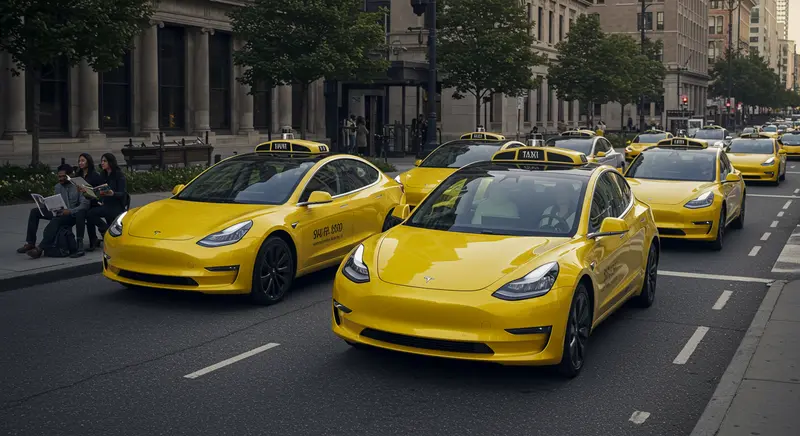
Tesla CEO Elon Musk always aims bigger. Last October, he showed off a two-door robotaxi. The gull-wing doors gave the car an almost masculine edge.
Without a steering wheel or pedals, the vehicle is as autonomous as it gets.
The billionaire entrepreneur said production would start as soon as 2026. The car will cost about $30,000 if you’re in the market to own a Cybercab.
Operating at $0.20 per mile, the Cybercab will use inductive chargers with no plugs and rely solely on cameras and AI. The features limit the need for additional robotaxi hardware.
Musk’s enterprising plan includes a self-driving Tesla taxi fleet, accessible via an app. Tesla owners can also list their vehicles as robotaxis to earn money.
Insurance Implications
Traditionally, commercial taxi insurance is created to meet the unique insurance needs of taxi companies. Collision coverage, liability protection, physical damage and rideshare insurance are legal requirements.
What happens when autonomous taxis take over our streets? Gulf News says as self-driving vehicles become commonplace, the commercial auto insurance industry must evolve.
Currently, personal auto coverage is based on human driver behavior. As the transport landscape changes, the commercial insurance industry must adapt to the complexities of AVs transforming into public hire taxis.
However, there is one common denominator – safety. Oswald Taxi and Transportation Insurance Services stresses the importance of taxi companies protecting their passengers, and vehicles from everyday hazards.
Scalability
Years of aggressive investment have enabled robotaxis to become part of the Phoenix cityscape. It’s a common sight to see self-drive taxis ferry their passengers from point A to B.
While the U.S. and China are leaps ahead, Europe is lagging. Fortune explains the continent’s lack of investment could be the reason.
Former CFO of ride-hailing app Gett Tal Brener tells the publication that U.S. venture capitalists are prepared to take risks on projects that have massive potential. On the other hand, European investors are more conservative.
The success of companies like Waymo is proof that years of development have huge payoffs. Brener adds that even though European firms dabbled in autonomous vehicles, they struggled to scale.
A case in point is Volkswagen’s attempt to launch a ride-hailing service in 2018. As of yet, the carmaker has yet to make the project commercially viable.
The Future is Now?
AVs have the ability to revolutionize how passengers experience transportation. The technology makes way for safer driving, less traffic, and more convenience.
On a sustainable level, self-driving cars tick all the boxes. Fully electric vehicles help reduce carbon emissions and pollution.
The mobility aspect will enable differently-abled or the elderly to hail a taxi. Efficiency-wise, autonomous taxis can operate longer without breaks.
On the safety front, advanced driver-assistance systems (ADAS) could reduce the number of accident fatalities.
Despite the positive spinoffs, driverless taxis come with challenges. Models will have to be extensively tested before being released to the public. A fully autonomous fleet may also require improving current infrastructure.
Nevertheless, the future of AVs looks bright. Are you coming along for the ride?
