
How Professional Heavy Haulers Help Prevent Catastrophic Highway Crashes
Heavy haul trucking is one of the most dangerous jobs on the road today.
Once a 200,000 pound load is shipped from one state to another, there is little room for human error. One wrong move can result in a domino effect crash that claims lives, closes down highways and incurs millions of dollars in damages.
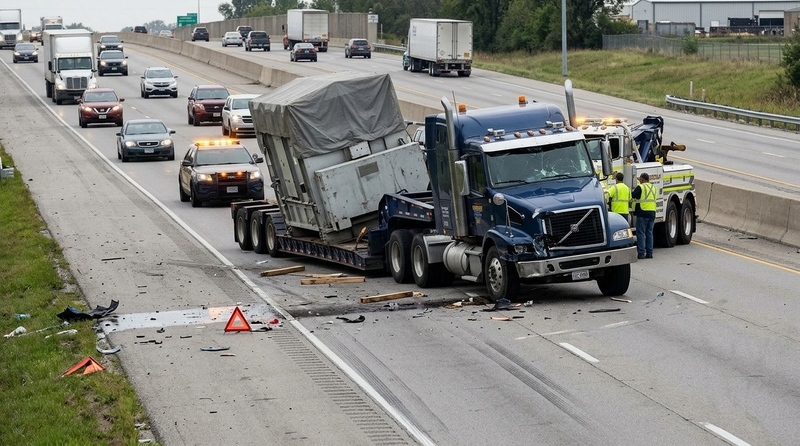
That’s the job of professional heavy haul contractors. They know how to train for, equip themselves and plan to move huge loads safely.
Here’s how it works…
What you’ll discover:
- Why Heavy Haul Crashes Are So Catastrophic
- The Role Of Professional Heavy Haulers
- The 5 Biggest Risk Factors They Manage
- How Multi-Axle Trailer Hauling Reduces Crash Risk
- What Sets Professionals Apart From The Rest
Why Heavy Haul Crashes Are So Catastrophic
Big trucks cause big damage. That’s just the simple truth.
A heavy haul rig carrying a load is 20-30 times heavier than the average passenger vehicle. When problems occur physics does not favor the tiny vehicle.
Statistics don’t lie. There were 5,218 large trucks involved in a fatal crash in 2024, which is a 30% increase over the past decade. It’s alarming when you think about just how heavy and difficult oversized loads can be to maneuver.
Here’s what makes heavy haul accidents different:
- The cargo can shift mid-transit and cause a rollover
- Stopping distances are much longer than regular trucks
- Loads can fall off and become deadly road hazards
- Other drivers can’t see around or past the truck
Heavy haul trucks involved in rollovers may bring large structures down with them. Bridges, overpasses, power lines can all come crashing down.
The Role Of Professional Heavy Haulers
This is where professional heavy haulers come in.
They are not your average truck drivers. These professionals train for years to learn how to safely transport oversized loads. They plot every mile of the route before the truck turns on its engine.
What’s the difference? Preparation, gear, and know-how. Those who know why choosing construction equipment transport services rather than standard trucking understand that hauling equipment on multi-axle trailers requires weight distribution, route surveys, and permits. Without all of these things in place the odds of a crash increase exponentially.
Professional heavy haulers handle the details that prevent disasters:
- Route surveys to check bridge weight limits and overhead clearances
- Permits for every state the load passes through
- Pilot cars to escort the load and warn other drivers
- Load securement that meets federal safety standards
- Driver training for handling oversized loads in traffic
It really is that simple.
The 5 Biggest Risk Factors They Manage
Heavy haul accidents don’t occur spontaneously. There is a failure at some point in the link. Professional heavy haulers know how to handle the risks before they become disasters.
Cargo Shift And Rollover
Running off the road is the leading reason. 32% of heavy truck accidents are caused by running out of their travel lane. Another 29% is caused by shifting cargo or system failure.
An improperly balanced load offsets the truck’s center of gravity. The most common result is a rollover, which is among the deadliest kinds of heavy truck accidents. Professionals avoid it by using chains, straps, and proper distribution.
Driver Fatigue
Long-haul truck driving is a tedious job. Hours-of-service regulations cap how many miles a driver can cover, but those are only effective if the driver abides by them. Commercial carriers enforce hours with ELDs and mandatory rest periods.
Brake Failure
Big trucks need big brakes.
Driving 100,000+ pounds down a mountain pass requires your brakes to be operating correctly. Pre-trip inspections and brake checks at every stop should be mandatory.
Route Hazards
Not all roads were meant to support great weight. Bridges have weight restrictions. Overpasses have height restrictions. Certain freeways were not designed to handle multi axle trailer towing weight distributions. Professional drivers map out these dangers beforehand.
Weather Conditions
Rain, snow and high winds make an ordinary haul a dangerous proposition. Professional haulers watch the weather along their route and find a place to pull over if necessary.
How Multi-Axle Trailer Hauling Reduces Crash Risk
Multi-axle trailer hauling is the gold standard for moving heavy equipment.
Why? Because each axle has multiple wheels. By adding more axles you spread the weight out over more wheels. Less weight on each axle which equals less stress on the road/tires/trailer.
The benefits are huge:
- Better weight distribution means less road damage
- More braking surface means shorter stopping distances
- Lower tire pressure per axle means fewer blowouts
- Improved stability means a lower rollover risk
Multi-axle trailer hauling is the only way some of the largest permitted loads are allowed on the road legally. If your trailer does not have enough axles to distribute weight you cannot get a permit for your load.
The previous point is significant because oversized loads are involved in about 1% of truck accidents. However, these types of accidents have a much higher fatality rate.
What Sets Professionals Apart From The Rest
Anyone with a CDL can drive a truck. You can’t just drive anything with a CDL. Not everyone can safely drive a 150,000 pound piece of construction equipment across the country.
The difference comes down to a few key things:
- Specialized training: Heavy haul drivers receive additional training and certification. During their training they learn specialized routing, oversized load handling, and emergency protocols.
- Better equipment: Professional carriers own trailers with several axles, hydraulic suspensions and improved braking systems.
- Coordinating with pilot cars: Occasionally, an oversized load will require pilot cars in front of and behind the transport truck. Pilot cars alert other motorists and can navigate through tight areas.
Insurance and compliance: Pros have proper insurance and comply with all regulations. Amateurs try to save money and end up with their cargo on the side of the road.
Understand why that’s important. Tractor-trailers need 20-40% more stopping distance than regular cars, particularly on wet pavement. A professional driver understands this and compensates. An amateur driver won’t.
Final Thoughts
Heavy haul trucking will never be completely safe. The cargo is just too large, and the road conditions too variable. However, professional heavy haulers minimize the risk of crashing by planning, preparing the proper equipment, and obeying traffic laws.
To quickly recap:
- Heavy haul crashes are some of the most catastrophic on the highway
- Pros use route surveys, permits, and pilot cars to prevent disasters
- Multi-axle trailer hauling spreads weight and improves stability
- Cargo shift, fatigue, and brake failure are the biggest risk factors
- Specialized training and equipment make all the difference
Moving heavy machinery? Don’t risk it with an amateur built carrier. Bring in professionals who know how to do it – there’s too much money on the line.
