
How a Clogged DPF or Failing EGR System Can Cause Dangerous Truck Breakdowns on the Highway
If you drive a diesel pickup, such as a Ford F-250, Ram 2500, or Chevy Silverado HD, your truck carries more than cargo. It carries a complex exhaust aftertreatment system that, when it starts failing, can turn your daily commute into a roadside emergency. And not just an inconvenient one. A sudden loss of power on I-10 or I-40 at 70 mph is a genuine accident waiting to happen.
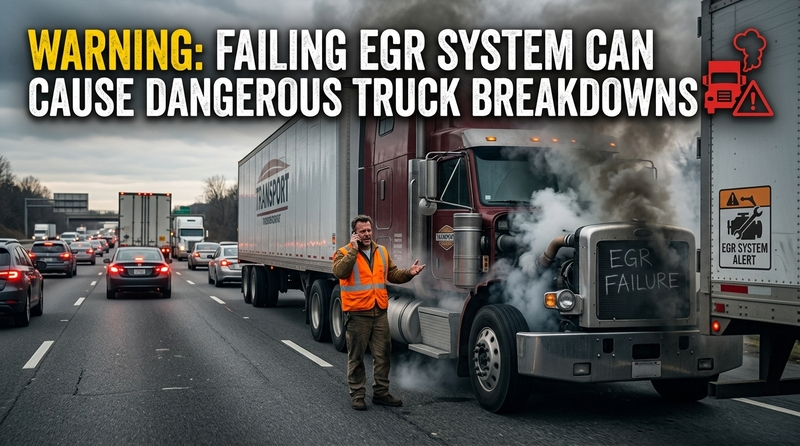
This article breaks down exactly how a clogged Diesel Particulate Filter (DPF) or a failing Exhaust Gas Recirculation (EGR) system creates dangerous driving conditions and what truck owners should know before they’re stuck on the shoulder with hazard lights on.
What Is a DPF and Why Does It Clog?
The Diesel Particulate Filter is part of your truck’s emissions control system. Its job is to trap soot and particulate matter from the exhaust before it exits the tailpipe. Over time, especially if you do a lot of short-haul, stop-and-go driving, the filter gets saturated with soot and needs to regenerate.
The problem? Regeneration requires sustained highway driving at higher RPMs. If your driving pattern doesn’t allow for it, the DPF never fully clears. Once it reaches a critical saturation threshold, your truck’s ECU triggers a series of increasingly severe responses:
- Reduced engine power (limp mode)
- Increased fuel consumption
- Rough idle and hesitation under acceleration
- Warning lights or complete engine shutdown
For a truck driver merging onto a highway or climbing a grade, a sudden drop to limp mode is extremely dangerous. You lose the ability to maintain speed, accelerate out of a dangerous situation, or even keep up with traffic flow.
The EGR System: A Different Failure, Same Dangerous Outcome
The EGR valve recirculates a portion of exhaust gases back into the engine’s intake to lower combustion temperatures and reduce NOx emissions. On paper, it’s an elegant solution. In practice, on high-mileage diesel trucks, it’s one of the most failure-prone components in the entire drivetrain.
When an EGR valve sticks open or closed, you get:
- Engine overheating, sometimes rapid and severe
- Rough running and misfires
- Black smoke under load
- Check engine lights and fault codes (P0401, P0402, P0404 are common culprits)
- Sudden stall at highway speed
A stalled diesel truck on a highway is one of the most dangerous scenarios a driver can face. You have seconds to get to the shoulder before other drivers behind you have no time to react. According to NHTSA data, vehicle breakdowns on the highway contribute to thousands of secondary crashes every year — crashes that injure or kill drivers and first responders alike.
How These Failures Lead to Real Accidents
Let’s be direct about the chain of events. It’s not just theoretical.
Scenario 1: Limp Mode During a Merge
A 2017 Ram 2500 with a clogged DPF enters a highway on-ramp. The driver accelerates to match highway traffic speed. The ECU, detecting critical DPF backpressure, cuts power to protect the engine. The truck slows dramatically. The driver behind, already committed to the merge, can’t stop in time, resulting in a rear-end collision.
Scenario 2: EGR Failure Causing a Stall
A 2015 F-250 with a stuck EGR valve is cruising at 65 mph. The engine, now running rich and hot, experiences a catastrophic coolant leak from the EGR cooler. The driver loses power suddenly and pulls to the right shoulder, but not before the truck drifts into the right lane during the maneuver. A semi-truck sideswipes them.
Scenario 3: DEF System Shutdown
A 2019 Silverado HD with a malfunctioning DEF (Diesel Exhaust Fluid) system receives a countdown warning: 200 miles until engine shutdown. The driver doesn’t understand what it means and keeps driving. The truck goes into full derate mode on the interstate, slowing to a crawl with no warning to drivers behind.
These aren’t fringe events. Diesel truck forums and NHTSA complaint databases are filled with reports exactly like these.
Liability When a Mechanical Failure Causes a Crash
If you were injured in an accident caused by a truck that lost power unexpectedly, determining liability isn’t always straightforward. Unlike a rear-end collision where fault is typically obvious, mechanical failure accidents involve multiple potential responsible parties:
- The truck owner/driver may bear liability if they ignored warning lights, skipped scheduled maintenance, or knowingly drove a vehicle with a known defect.
- The manufacturer may be liable if the DPF or EGR system failed prematurely due to a design defect. Ford, for example, faced class-action litigation over the 6.0L and 6.4L Powerstroke EGR cooler failures, systems that caused overheating and catastrophic engine failure in hundreds of thousands of trucks.
- A third-party mechanic or shop could be liable if they serviced the emissions system and failed to properly diagnose or repair it.
If you were involved in an accident where a diesel truck’s sudden breakdown or loss of power was a contributing factor, consult a personal injury attorney who understands vehicle mechanical liability. Documenting the fault codes stored in the truck’s ECU at the time of the incident can be critical evidence.
What Diesel Truck Owners Can Do to Prevent These Situations
Prevention is the better path. Proactive maintenance and understanding your truck’s emissions system goes a long way toward avoiding dangerous breakdowns.
- Know your warning lights. A solid DPF light means your filter needs a regeneration cycle. A flashing DPF light means you’re already in reduced power mode. Don’t ignore either.
- Allow regular highway regen cycles: If you primarily drive in town, take your truck for a sustained 20-30 minute highway drive at least weekly to allow passive regeneration to occur.
- Monitor EGR cooler coolant levels: A sudden drop in coolant level, especially on 6.0L or 6.4L Powerstrokes, is often the first sign of EGR cooler failure. Catch it early.
- Address fault codes immediately: A P0401 or P242F code isn’t something to clear and ignore. These are your truck’s way of telling you it’s operating outside safe parameters.
- Consider upgraded or delete-capable aftermarket solutions: Many diesel truck owners turn to diesel delete kits to eliminate the DPF and EGR systems entirely, removing the most common failure points from the drivetrain. Brands like EngineGo offer vehicle-specific DPF and EGR delete solutions engineered for Powerstroke, Cummins, and Duramax platforms. Truck owners report dramatically improved reliability, throttle response, and fuel economy after removing clogged aftertreatment systems.
- Pair any exhaust work with proper tuning: Removing or modifying exhaust components without reflashing the ECU will leave your truck running incorrect fuel trims and throwing codes. Providers like EngineGo often supply matched diesel tuners alongside their hardware kits, ensuring your specific engine has the essential drivability and long-term reliability it needs after an upgrade.
The Bottom Line
A clogged DPF or failing EGR system isn’t just a maintenance headache. In the wrong situation — such as merging at highway speed, climbing a mountain grade, or navigating heavy traffic — it’s a safety hazard that can cause serious accidents. The mechanical failures don’t announce themselves politely. They happen fast, often without adequate warning for the driver or anyone around them.
If you’re a diesel truck owner, staying ahead of your emissions system health is one of the most important things you can do for your own safety and the safety of other drivers on the road. And if you’ve been involved in an accident where a vehicle’s unexpected mechanical failure played a role, understanding the liability picture is critical to protecting your rights.
Whether you choose proactive maintenance or decide to eliminate these risky components entirely with an aftermarket EGR/DPF delete kit, the key is not waiting until you’re stranded on the shoulder of a busy freeway. If you’re ready to bulletproof your diesel truck and prevent these dangerous highway breakdowns, visit enginego.com to find the exact performance parts and delete kits engineered for your specific make and model.
