
How Much Does an Accident Devalue a Car? Complete Guide
A car accident is not only emotionally distressing but also physically and financially agonising. You got into someone or they did into you, either way, you will end up finding your car damaged. An accidented car instantly loses its actual market value.
Only insofar as you are a buyer, should you invest in buying an accidented car? Many discussions and debates spark across automobile forums, considering a devalued accidented yet professionally repaired vehicle over a brand new or a non-accidented one. Let’s crack this hard nut for you:
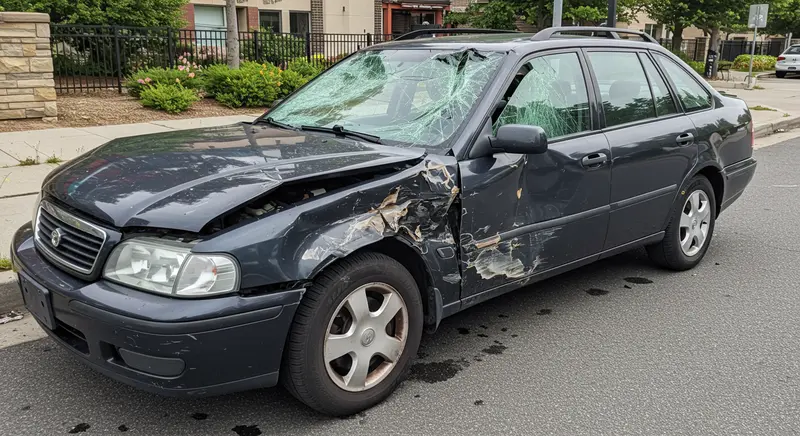
What Is Diminished Value After a Car Accident?
Diminished value is the price difference between the vehicle’s market value before and after the accident. In layman’s language, it is simply the amount of money your car loses in resale value after the accident.
In most cases, cars are repaired, and even if they are, buyers are not willing to pay much more, even if the vehicle looks great and works perfectly, because it now has an accident history.
However, there are three main types of diminished value:
- Immediate diminished value: It refers to the instant resale value difference immediately after an accident, without any repairs.
- Inherent diminished value: It is the resale value difference because the car has been in an accident, no matter how well repaired.
- Repair-related diminished value: It is the additional price resale value difference after the repair, where buyers argue the normal repairs and use of non-OEM parts, or visible signs of repair.
In either case, a 10% base loss cap is instantly applied as soon as a car hits or gets hits to the pre-accident market value. Customer behaviour and insurance companies‘ reports show that 9 out of 10 buyers are unwilling to buy full value for vehicles with a minor accident history.
How Do Car Accidents Impact Resale and Trade-in Value?
According to statistics, a car can lose up to 30% of its typical value right after the accident, owing to the buyers’ mindset of not buying an accidented car. However, in case of major accidents or severe ones, a vehicle can also lose 50% of its value. On average, as we calculated, you can expect a car to lose somewhere between $2000 and $3000 on its resale.
Which Factors Affect How Much Value a Car Loses
Whenever a car is involved in an accident, it immediately loses some extent of its value, which Carfax reports to be nearly 10% to 25% of its actual value before the accident. However, that’s not the only case; other factors are considered. Some of them are
1) Age and Mileage of the Car
Age and mileage are the simplest factors contributing to losing its actual value. However, the most commonly used diminished value calculation formula is the “17c formula,” where mileage is a multiplier for value loss.
For instance, in the case of a vehicle, here are the multiplier examples:
- 0–19,999 miles: 1.00
- 20,000–39,999 miles: 0.80
- 40,000–59,999 miles: 0.60
- 60,000–79,999 miles: 0.40
- 80,000–99,999 miles: 0.20
- 100,000 miles or more: 0.00,
Not only that, vehicles with high mileage will have more depreciation than those with fewer miles. This rule is industry-standard, no matter what make, model, or condition. In the used automobile market, cars lose an average of ~ 20% of their value after the first 20,000 miles.
2) Type of Accident and Repairs Needed
Since car depreciation after an accident has now become a complex science, at least for someone who’s not much into it every day. As per statistics, on average, a vehicle will or can lose 5% to 10% of its value if involved in a minor accident (with minor paint job or bodywork,) whereas 10% to 15% for major accidents.
3) Vehicle History Reports (Carfax, AutoCheck)
Average Value Reduction Due to Accident History
A Carfax report says that cars or vehicles without less severe damage lose nearly $300 to the wholesale value, while $400 to the retail value, which means that even an accident near your car takes much off its value.
4) Retail Price Impact of Damage Reports
No matter how you got into an accident or what the damage was, if your car is reported as an accident, its retail price will immediately drop by $500. If the damage is labeled severe, the loss can easily exceed $1,700.
Average Percentage Loss After an Accident
Based on our findings from multiple data sources, we can confidently conclude that any vehicle that goes into an accident can generally lose 10 to 30% of its immediate value.
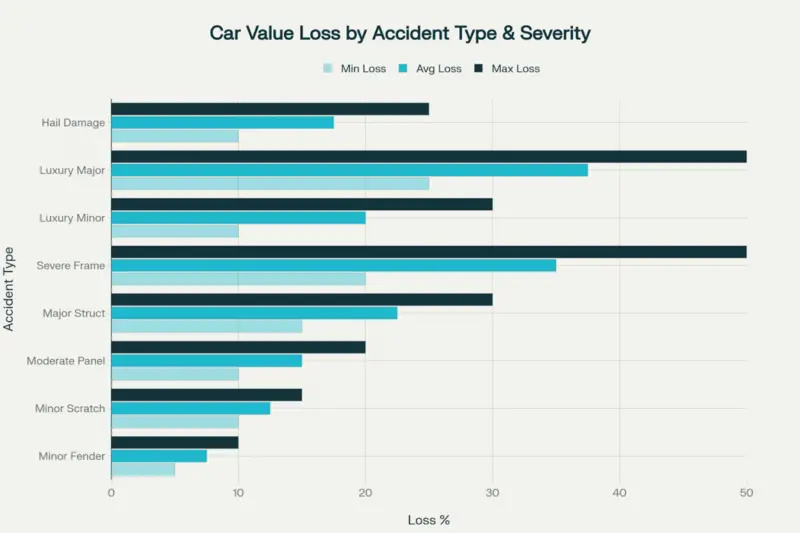
Here’s how much a minor or major accident can affect the value:
Minor Damage
- Fender Bender: 5-10% loss (average 7.5%)
- Scratches/Scuffs: 10-15% loss (average 12.5%)
- Panel Replacement: 10-20% loss (average 15%)
Major Damage
- Structural Damage: 15-30% loss (average 22.5%)
- Frame/Airbag Deployment: 20-50% loss (average 35%)
- Hail Damage: 10-25% loss (average 17.5%)
Luxury Vehicle
- Minor Damage: 10-30% loss (average 20%)
- Major Damage: 25-50% loss (average 37.5%)
Our recent research shows these estimates are typically based on market depreciation, accident severity, and vehicle type. Also, vehicles with accident-damage history depreciate 25% faster than non-accidented vehicles.
How Insurance Companies Handle Diminished Value?
Since insurance companies are always ahead of market dynamics, they are well aware of the automobile industry depreciation and accidental price losses as well. Companies take a different resistive approach to diminished value claims.
Both buyers and owners should recognise the following types of claims:
- First-Party Claims: In simpler terms, when you hit your car into someone’s or into something, you will call your insurer to pay for the diminished value of your vehicle after the repair. But, mostly, insurers simply deny it, whereas Georgia is the only state that mandates its insurance companies to fully compensate the diminished values within.
- Third-Party Claims: Put another way, if you got into an accident without some, you can file a claim with his/her insurer. In most cases, third-party claims are almost approved for diminished value claims. This is because the other driver’s insurance company is entirely responsible for covering the entire loss in your car’s value after repairs.
Tips to Reduce Car Value Loss After an Accident
- You should always prefer automobile repair from a certified repair shop, and ask for OEM parts replacement instead of uncertified repairs, which can additionally cause a loss of 5–10% of the car’s value.
- You should always keep a detailed record of repairs, which includes receipts, photos, and inspection certificates. This helps buyers understand the nature of the repair and can improve resale value by up to 10%.
- You should immediately file a diminished value claim, as otherwise, your car is going to sell 5–15% less anyway. First-party claims have only a 5 to 10% success rate, whereas third-party claims succeed in about 99% of cases.
- You should quickly gather evidence supporting the damage for insurance claims and resale trust. These documents can be photos of damage, police reports, or video of the accident.
Diminished Value Claims: What You Need to Know
Most buyers whose car was accident yet repaired fall in the category of diminished value claims. Mostly, third-party claims have 99% chances of approval when another driver is at fault and their insurance covers the loss.
You can begin filing a diminished value claim by determining the car’s pre-accident value from Kelley Blue Book, Edmunds, or NADA. Afterwards, you should also keep the repair invoices, photos of the damage, and inspection reports with you when dealing with the issue
Besides everything, you should be mentally prepared for negotiations with insurers, as they are always willing to settle for a lower amount unless strong evidence or an independent appraisal supports your case.
Bottom Line
A diminished value claim allows you to claim and get the loss of your vehicle’s pre-accident marketplace pricing. In most cases, the other driver is ready to pay if your car was damaged in an accident caused by another driver. No matter what, the repairs still have an impact on the vehicle market value.
