
What Drivers Should Know About Semi-Truck Weight Laws
Semi-truck weight laws are in place to ensure the safety of drivers, bridges, and highways. Federal and state agencies have regulations on truck weight, its distribution, and when permits are required to transport an oversized load.
Violations may result in substantial fines, out-of-service status, or liability following an accident. Many motorists are wondering about unloaded truck weights, particularly when driving without a load or towing an empty trailer.
Questions like ‘How much does a semi-truck weigh without trailer in tons?’ often come up because empty weight still affects bridge limits, braking distance, and legal compliance. Let’s find out more!
What Is the Federal Weight Limit for Semi Trucks?
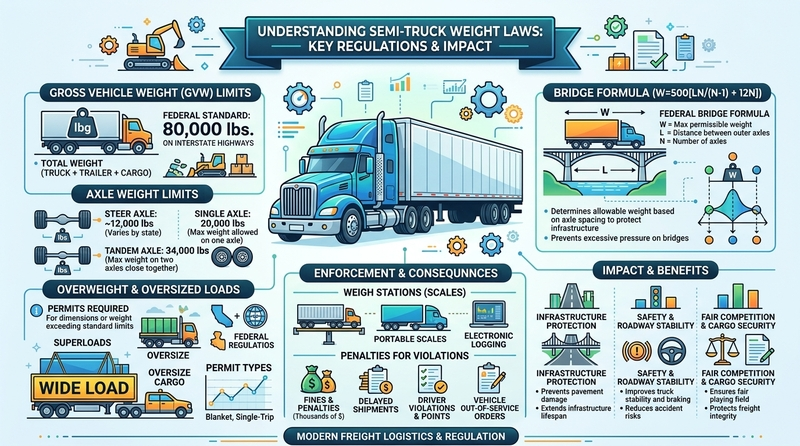
The federal weight limit for semi-trucks is 80,000 pounds. The federal weight limit for semi-trucks is 80,000 lbs.
The most common 5-axle tractor-trailers are restricted to:
- 80,000 lbs. gross vehicle weight
- 20,000 pounds supported by a single axle
- 34k lbs. (34,000 gross) on tandem axles
These limits are applicable to the Interstate Highway System as defined in 23 CFR § 658.17. States may establish their own standards for local roads, with a basic standard being the Interstate standards.
The Federal Highway Administration Bridge Formula also takes into account the distribution of weight across axles. An 80,000-pound truck could still be in violation of the law.
Why Axle Weight Matters
The distribution of weight is as important as the overall truck weight. Excessive loading on a single axle can cause tires to go flat, brakes to fail, and even bridge damage.
For instance, if there is excess weight near one of the axle groups of a truck with steel coils, then that truck will not pass inspection at 78,000 pounds. That’s why weigh stations inspect gross weight and axle spacing.
An overloaded truck may go out of service until the load is corrected.
How States Enforce Semi-Truck Weight Laws
The process by which states enforce semi-truck weight laws can be complicated.
Roadside weigh stations, portable scales, and inspection checkpoints are used throughout the state to enforce trucking regulations. Avoiding the penalties for speeding will cost you if you break the law, such as:
- Per-pound overweight fines
- Delays and mandatory unloading
- Permit violations
- Increased insurance exposure after accidents
Some states impose higher penalties for repeat violations. In serious cases, an overweight operation may support negligence claims after a collision.
Truck accident laws can also affect liability when a crash involves overloaded commercial vehicles.
Are Empty Trucks Still Subject to Weight Laws?
Yes. Restrictions and axle laws apply to any tractor or trailer, even when empty. Many drivers would wrongly think that only loaded trucks are regulated.
A bobtail tractor weighs from 15,000 to 25,000 pounds, and a tractor with an empty trailer can be in excess of 35,000 pounds. There is often confusion in conversations among CDL drivers about whether bridge limits apply to actual weight or registered capacity.
The majority of enforcement is based on the actual operating weight. This is important when crossing an older bridge or a local road with a lower posted speed limit.
Key Takeaways
- Federal interstate truck weight restrictions typically limit truck weight to 80,000 pounds.
- Typically, single axles support 20,000 pounds.
- The weight of tandem axles is usually limited to 34,000 lbs.
- Axle spacing and the distribution of weight are controlled by the Federal Bridge Formula.
- Empty trucks and bobtail tractors will continue to be subject to bridge and weight restrictions.
- Other penalties and permits may be imposed at the state level.
- Post-crash safety issues and liability can be exacerbated by weight violations.
