
How a Single Semi Tire Blowout Can Trigger Catastrophic Interstate Pileups
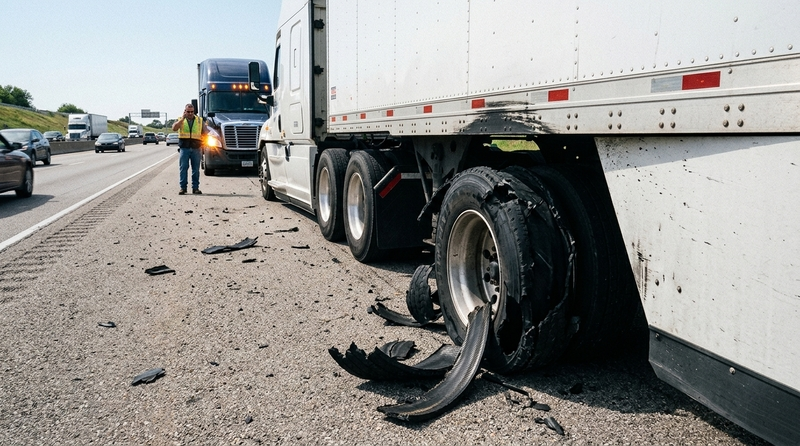
It is a sound that any seasoned interstate driver dreads: a sudden, explosive boom echoing across the asphalt, immediately followed by a cloud of shredded black rubber and a violent plume of smoke. When a normal passenger car hits a tire blowout, it’s a kind of panic emergency. But when a 12-ton semi-truck moving at around 70 mph gets the same kind of failure, it can suddenly turn a very coordinated stretch of highway into something close to a total mess. The raw physics of a big commercial vehicle means that one tire issue seldom stays “one vehicle only.” It often kicks off a chain reaction that leaves dozens of motorists stranded nearby. So if you, or someone you love, got caught in the aftermath of this kind of disaster, contacting catastrophic truck accident attorneys can be a major step. It helps clarify the messy liability questions and the regulatory breaches that are so often underneath these large-scale roadway failures.
The Immediate Physics of a Semi-Truck Blowout
To really get why a semi-truck blowout is so uniquely risky, you have to look at the extreme forces involved. A fully loaded commercial vehicle can tip the scales at about 80,000 pounds. That mass depends on 18 tires to keep dependable traction and steadiness on the road. When one tire fails structurally at speed, the whole balance of the truck lurches out of alignment in a split second, like the vehicle loses its “foundation” all at once.
If the blowout happens on a front steering axle, the outcome can become difficult to manage almost instantly. The truck yanks to the side of the deflated tire, often with an aggressive pull. The driver then has to wrestle with major rotational forces just to hold the rig in its lane. And if the failure is on a rear drive tire or a trailer tire, the sudden loss of support can cause the trailer to swing unpredictably. That’s when a dangerous event, often called jackknifing, can take over, where the trailer skids sideways and folds inward toward the tractor.
The Chain Reaction: Creating a Pileup
A tire blowout rarely happens in a vacuum. On modern interstates, vehicles travel in tight, high-speed clusters. When an 18-wheeler suddenly loses control, it sets off a rapid progression of hazards for everyone sharing the road:
- The Debris Field: A disintegrating semi tire does not just go flat; it explodes into massive, heavy chunks of steel-belted rubber called “alligators.” These projectiles can crash through the windshields of passing cars or become lodged beneath smaller vehicles, causing trailing drivers to lose steering control.
- The Swerve Response: When a massive piece of rubber suddenly appears in the road, the natural human reflex is to swerve. At highway speeds, a sudden lane change often causes drivers to strike neighboring vehicles or lose traction entirely, spinning out into adjacent lanes.
- The Overwhelming Footprint: A jackknifed semi-truck or a rolling trailer can span across three or four lanes of traffic simultaneously. On an interstate, this creates a literal wall of steel. Trailing drivers, even those maintaining a legal following distance, are given only seconds to react to an obstacle that completely blocks their path.
The Role of Highway Speed and Stopping Distance
A passenger car traveling 65 mph usually needs about 300 feet, more or less, to come to a full stop once the driver sees the hazard.
Now, if a semi truck blows a tire and it blocks the highway, it wipes out that required “buffer” for the cars directly behind it. And if the view is already reduced by night, rain, or fog, then the risk ramps up; not just a little, but exponentially. First, one car brakes hard, and then gets struck from the rear. After that, the next car hits the wreckage, and soon a small mechanical breakdown becomes a bigger chain reaction, with the wreckage stretching for hundreds of yards down the interstate.
Conclusion
Dealing with the fallout of a massive interstate pileup is a messy legal maze, with a host of insurance companies, transport corporations, and injured parties offering differing versions of what happened. That’s why it’s important to work with catastrophic truck accident attorneys. They help ensure that logbooks, maintenance records, and black box data are secured straight away and thoroughly checked, so it is possible to tell who is really to blame. By holding the commercial transport industry to strict accountability, we can ensure that maintenance remains a priority even when it cuts into profit margins, making our shared interstates safer for all those out there driving.
