
Why Sudden Steering System Failures Leave Drivers With Almost No Time to React
Among all mechanical issues a driver can face, a sudden steering system failure is uniquely terrifying because it completely bypasses the standard human timeline for defensive action. When the brakes fail, you can pump the pedal, use the emergency brake, or steer to a soft place. When your steering fails, your primary means of self-preservation is instantly neutralized. If you or someone you love has been involved in a crash resulting from a mechanical defect, aligning yourself with trusted car accident attorneys can ensure that electronic data, manufacturing records, and maintenance logs are preserved to uncover who is truly liable. Understanding the physics of this sudden catastrophe reveals why reaction times drop to zero.
The Mathematical Reality of High-Speed Travel
The simple, brute-force mathematics is the main reason a driver cannot effectively respond to a steering failure. When a vehicle is traveling at highway speeds, the distance traveled in the blink of an eye is huge.
- At 60 mph: A vehicle travels 88 feet per second.
- The Reaction Window: The average human perception-and-reaction time in an emergency is roughly 1.5 seconds.
- The Distance Covered: Before your foot can even touch the brake pedal after realizing something is wrong, your vehicle has already traveled 132 feet completely unguided.
In an urban setting or on a multi-lane highway, drifting blindly for more than 130 feet basically means you will almost certainly end up in oncoming traffic, hit a concrete barrier, or slide off the road into a stationary obstacle before your brain can even sort out what happened, and why the steering wheel just feels dead.
The Physical Signs of Component Failure
Unlike a failing engine that might cough, sputter, or emit smoke, steering systems sometimes fail with zero warning to the driver. The mechanical setup depends on a rather intricate line of high-stress parts, and when the structure of any one link gives out, the chain can fail, leading to a complete loss of control:
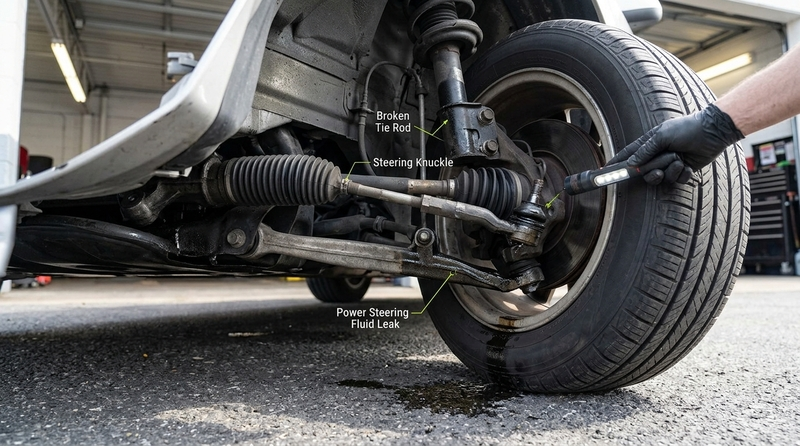
The Tie Rod Catastrophe: Tie rods connect your steering gear to the wheel assembly. If a worn tie rod snaps, the affected wheel is completely disconnected from your steering inputs, causing it to flop sideways and violently pull the car into a sharp turn or rollover.
Similarly, a sudden loss of power steering fluid due to a ruptured hose or a catastrophic electrical failure in modern Electric Power Steering (EPS) units can instantly increase the steering resistance by four- or five-fold. A driver who is accustomed to effortless, power-assisted steering suddenly finds it physically impossible to turn the wheel fast enough to negotiate an impending curve.
Why Traditional Defensive Driving Fails
Driver education courses spend hours teaching motorists how to handle skids, hydroplaning, and tire blowouts. All of these defensive techniques rely on one absolute prerequisite: the ability to steer toward danger or recovery.
When the steering system fails due to a structural breakdown, regular defensive driving tactics can feel kind of useless, or at least not as “helpful” as people expect. If your vehicle starts sliding toward a guardrail and your steering inputs do not actually reach the front wheels, you can tap the brakes to reduce the force of the later impact, but it still cannot stop it. In practice, this leaves drivers feeling completely trapped, and that alone can pile on psychological trauma from the whole event.
Conclusion
Getting through the aftermath of a high-speed mechanical crash is an extremely complicated process, mainly because vehicle manufacturers and insurance corporations will typically try to point the finger at “driver error” for where the vehicle ends up going. Working with trusted car accident attorneys gives your family an important layer of protection. A dedicated legal team will use forensic engineers to examine the damaged parts, recover the vehicle’s black box data, and then push hard for the fair compensation you need to truly recover. Keep your maintenance routine tight, watch for weird clicking or faint knocking when you turn, and treat your steering system with the kind of care a high-speed environment simply requires.
