
What Happens If My Drive Shaft Breaks While Driving?
The drive shaft is an important part of the transmission system of a vehicle that is charged with the transmission of power derived from the engine to the wheels. It joins the transmission to the differential and makes the wheels turn in four-wheel drive, all-wheel drive, and rear-wheel drive cars. With a steel or aluminum cylindrical metal shaft, this is a highly stressed part that is under stress, particularly during accelerating, braking, and cornering.
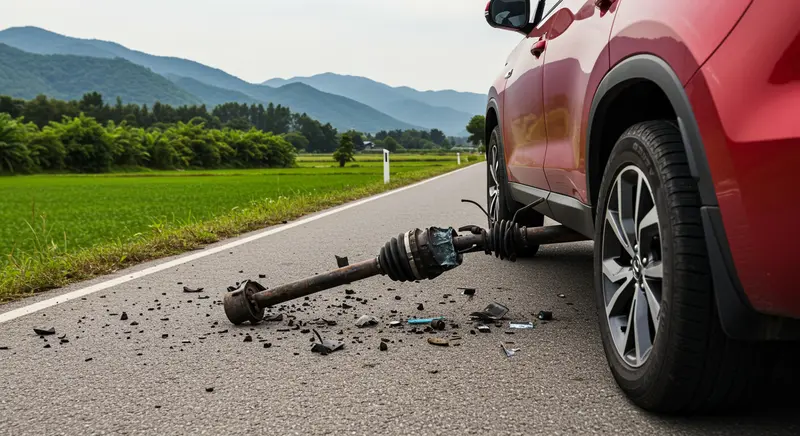
In case there is a breakage of the drive shaft when you are on the road, the result could be as mild as inconvenient or a bad case of hazard. This mostly depends on how fast you are as a motorist and the conditions on the road, and the type of brake. Let’s have a look at the causes of drive shaft failure:
Causes of Drive Shaft Failure
The failure of drive shafts does not usually come without any warning. Most of the time, the issue is formed with time through wear and tear or outside damage. Most frequent ones are:
- These are universal joints (U-joint), constant velocity (CV) joints, which get dry and brittle when worn due to a lack of lubrication. When such joints wear out, there will be a possibility of a wobbling, vibrating, or disassembled shaft.
- The shaft structure becomes weak due to corrosion and rust, which, especially in snowy or salty road areas, is prone to cracking or breaking.
- Torque or overloading may place unnecessary stress on the shaft, which may be caused by towing with more weight than your car can pull or by quick acceleration.
- Poor suspension modification, such as lift kits, by changing the angle of the drive shaft, may provide mechanical stress that it is not equipped to deal with.
- The shaft can also be bent or broken due to physical impact, like when you hit a huge pothole or a curb, or anything on the road.
There are good reasons that do not lead to immediate failure. Rather, they will have the effects of progressively causing weakening or imbalance until one day the drive shaft snaps, especially when subjected to high stress.
Symptoms Will Suggest Before the Drive Shaft Breaks
Luckily, the drive shaft will usually show several symptoms before total failure. They can help you act before it is too late and prevent a breakdown:
- Bouncing underneath the car, especially when accelerating. This is usually the most evident and the first.
- Noises such as clunking or banging, especially during gear changes or when taking a corner. The sounds may mean bad joints or misalignment.
- Shuddering as accelerating, this may be caused by the imbalance as well as worn joints.
- Leaking grease coming out of a ripped CV boot, and it indicates the joint is open and vulnerable to breaking.
- Trouble turning or sensation of loose steering dynamics, particularly on a front-wheel or all-wheel-drive automobile.
One should not disregard these symptoms. Early detection of a problem may be as simple as replacing a U-joint or boot that may have saved your breakdown; you could be in serious trouble and shell out all your money.
When the drive shaft breaks in mid-drive, what happens?
When you are driving and the drive shaft is broken, the immediate effects may be different due to the condition of the vehicle and the speed during driving.
Rear-Wheel Drive
Broken drive shafts in vehicles that have the drive wheels in the rear will frequently result in complete loss of power to the back wheels. The vehicle can unexpectedly slow down, and it will seem that it has been put in neutral.
As you drive at high speeds, the sudden variation of the force may cause you to lose control of the rear end of your car. In the very severe cases, it may just snap off outright and strike the undercarriage or the fuel line or even the road beneath you, and this might make your car swerve off or even skid off.
Front-wheel drive: Loss of Power & Difficult Handling
In front-wheel-drive cars, the shaft is divided into left and right axles where the wheels run on the chassis by connecting the axle and the wheel with CV joints.
Failure on one of the sides might leave you with partial control of the car, and most possible, it will lack power and will be tough to control, especially when accelerating or turning.
Damage Caused by Drive Shaft Failure
In 4WD or all-wheel-drive cars, failure of the drive shaft may break several elements in the drivetrain at the same time, and the vehicle becomes useless, or the differential, transmission, and other associated parts may suffer strain.
With a broken drive shaft in any setup, one can expect to hear loud sounds, either metal grinding or clunking, and either partial or full loss of control. A worse situation may arise when the shaft breaks and swings back and forth, causing devastating destruction to brake lines, fuel tanks, or exhaust.
Possible Hazards and Losses: Safety Risks
A damaged drive shaft not only creates inconvenience; it is also a possible safety hazard. When you have high speed and you suddenly lose propulsion or control, chances are high that you are going to crash and especially when you are on the highway or on a busy road. The vehicle can become erratic, drift, or cross a hazardous location.
In addition to the imminent risk to the life and safety of the driver, as well as passengers, the resulting mechanical damage may be extensive. A damaged shaft may rip through the underbody of the vehicle, chew up the transmission or differential, and tear apart the vital parts of the vehicle, such as brake lines or fuel pipes. The repair price could rise significantly once the damage has become extensive.
As well, in case of the failure where the liquid leaks out – transmission fluid, gear oil, etc. – and the driver keeps on using the engine, the inner components may be destroyed by the heat and friction. This is what makes the failure not only dangerous but rather financially devastating.
What to Do When Your Drive Shaft Breaks While Driving?
Provided that you have a suspicion that your drive shaft can already break or has already broken on your drive, keep calm and do the following:
- Do not become panicked or brake brakes. The vehicle might be unstable in case of sudden braking, more so when the shaft has damaged the underbody or driveline.
- Lift your accelerator pedal a little and allow the car to decelerate.
- Turn on your hazard lights so that other drivers can see.
- Move the car to the roadside slowly. Do not move in sharp turns.
- When you have a stop, switch off the engine, and call a roadside assistance or towing company.
- Do not even seek to drive again, regardless of how the car seems to be moving. The damage can be augmented by driving the car, or a second failure will occur.
- The best thing to do is to remain in the vehicle and wait until help arrives, unless you notice smoke or smell gasoline, in which case, leave the place as quickly as possible.
Costs of Repair and Replacement
Repair of a broken drive shaft varies in terms of the type of vehicle, the extent of damage, and the labor rates in your area. In general:
- Replacement of U-joint or CV joint: $150 to $400
- Full drive shaft re-work: $400 to $1,200
- Transmission or differential repair/replacement (on the assumption that repairs are done): $800 to $3,000 or more
It never pays to be cheap on your repairs early; a worn joint or boot is much cheaper to replace than the costs of the aftermath of a shaft failure.
Prevention of Drive Shaft Failure
Avoiding drive shaft failure is as simple as properly inspecting it on a regular basis, maintaining it, and driving it smartly. Here are some of the tips:
- Undersides of any vehicles should be checked regularly, in particular, in case you live in uncertain areas with bad roads or harsh weather. Inspect the boot of the CVs, any rust or grease leakages.
- Pay attention to abnormal noises (clicking, thudding, or grinding) and take care of them as soon as possible.
- Do not overload your car, in particular, when you tow something or carry a heavyweight.
- Replacing the joints or shafts is to use good quality parts- the low cost cannot resist stress over the long term.
- Do not drive aggressively, sudden acceleration, or veer the vehicle off-road unless it is designed to do so.
- Change your drivetrain, or service it at the recommended intervals, and also get everything well-lubed and aligned.
- When properly taken care of, a drive shaft can last the whole life of the vehicle.
Conclusion
When a drive shaft breaks, driving the car is a very high-order mechanical failure that may result in the loss of power, control, and even safety. Although all these incidents are quite minor, they can almost always be avoided. The car usually provides several indicators that should not be overlooked, including vibrations, unusual sounds, and grease leaks.
In the event of a drive shaft failure during operation, being able to react and respond in a safe manner that avoids further damage and potential accidents is crucial. The best defense against them is to inspect and maintain regularly. Maintain your cars properly, keep your eyes open, and you will be in a great position to avoid this type of mechanical failure.
It is much more effortless -and affordable- to prevent than to fix.
